 India GO
Mahavir Jayanti: the birthday of Mahavira
A birthday kept in the spirit of nonviolence
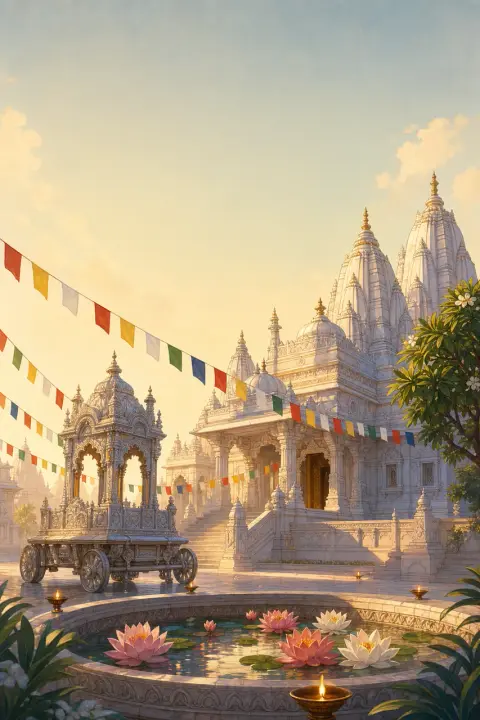
Mahavir Jayanti is the Jain festival of the birth of Mahavira, the twenty-fourth and last Tirthankara, the "ford-maker" of the Jains for this age. It falls on the thirteenth day of the bright half of the month of Chaitra, in late March or April: 19 April 2027. In the temples his image is ritually bathed, a decorated chariot carries it through old-city lanes, devotees dress in white, and the day is spent in giving, in the spirit of ahimsa, nonviolence towards every living being.
The birth of Mahavira, the twenty-fourth Tirthankara of the Jains, kept with temple rites and processions
The thirteenth lunar day of the bright half of Chaitra. The central government's holiday list for the year, issued around July of the year before, confirms the day.
The legend
Tradition says that before her son is born, Queen Trishala sees a series of auspicious dreams foretelling a great soul.
When he is born, the god Indra bathes the infant on Mount Meru from 1,008 sacred vessels.

The boy is named Vardhamana, "the one who grows", for the kingdom prospers from his birth.
So on his day Mahavira's image is bathed in the temples, echoing that bath on Meru.
Meaning
Vasokund
The family that owns the plot called Ahalya bhumi has left it unploughed for centuries: it is revered as Mahavira's birthplace.
Pawapuri
The Water Temple stands in a pond of red lotuses where he was cremated: the pond formed where pilgrims carried away the sacred soil.
Customs
The chariot
Mahavira's image rides through the streets on a chariot, with stavans, Jain hymns, sung along the way.
Ahimsa runs
Runs and rallies are held for ahimsa, non-violence towards every living being.
Sermons
Monks and nuns give sermons in the temples on the path of virtue.
Giving
On this day Jain communities feed those in need and give to animal shelters and to care for the sick, in the spirit of ahimsa.
Words of the festival
जिन
jina
"conqueror" of the inner passions; Jains are "followers of the conquerors"
पंचकल्याणक
Pancha Kalyanaka
"five auspicious events" in every tirthankara's life; birth is the second
णमोकार मंत्र
Namokar Mantra
the central Jain mantra; its first line was carved in stone over two thousand years ago
How to greet
जय जिनेन्द्र
Jai Jinendra!
"Victory to the Lord of the Jinas!", the everyday Jain greeting, for meetings and festivals alike.
True or myth
✅ True. Svetambara texts say the commander of Indra's army moved the embryo from a Brahmin woman to Queen Trishala; Digambaras reject the legend.
❌ Myth. Svetambaras count fourteen dreams, Digambaras sixteen.
✅ True. Tradition places his birth in Vajji, a ganarajya with its capital at Vaishali, where the king was elected by vote.
Whose birthday it is
Jains honour twenty-four Tirthankaras, the ford-makers who found a crossing over the river of rebirth and showed it to others. Mahavira, the last of them, was born Vardhamana, "the one who grows", to Queen Trishala and King Siddhartha in Kundagrama, identified with the Vaishali area of present-day Bihar. Jain tradition dates his birth to 599 BCE; many historians place his life somewhat later. At about thirty he left the palace, and after more than twelve years of austerity he attained kevala jnana, complete knowledge. He taught for some thirty years and reached nirvana at Pavapuri, a night Jains remember at Diwali. More: Mahavira.
Birth is the second of the Pancha Kalyanaka, the five auspicious events in every Tirthankara's life, and the legends of the day explain its rites. Before he is born, Queen Trishala sees a series of auspicious dreams foretelling a great soul: the Svetambaras count fourteen, the Digambaras sixteen. When he is born, the legend goes on, the god Indra bathes the infant on Mount Meru from 1,008 sacred vessels, and so on Mahavir Jayanti his image is bathed in the temples. The Svetambara texts also tell that the commander of Indra's army moved the embryo from a Brahmin woman to Queen Trishala; the Digambaras reject this legend.
The date follows the moon: the thirteenth day of the bright half of Chaitra, which lands between late March and late April. The day is one of the compulsory holidays on the central government's list, issued around July of the year before.
How the day is kept
Mahavir Jayanti is a gentle morning festival in Jain neighbourhoods rather than a citywide event.
- Abhisheka in the temples
The day begins with abhisheka, the ritual bathing of the Tirthankara's image, followed by prayers and readings.
- The chariot procession
An image of Mahavira rides through the streets on a decorated chariot or palanquin, with music and stavans, Jain hymns, sung along the way, and devotees dressed in white.
- Sermons
Monks and nuns give sermons in the temples on the path of virtue.
- Giving and ahimsa
Jain communities feed those in need and give to animal shelters and to care for the sick; runs and rallies are held for ahimsa.
Where to see it
The festival is kept wherever there is a Jain community; these are the places where it is worth seeing if you are there.
Delhi, Ajmer, Kolkata
Vaishali and Pawapuri, Bihar
The places of his birth and his nirvana. At Vasokund near Vaishali, a plot called Ahalya bhumi has been left unploughed for centuries by the family that owns it, revered as his birthplace. At Pawapuri the Water Temple stands in a pond of red lotuses where he was cremated; the pond is said to have formed where pilgrims carried away the sacred soil.
Visiting a Jain temple on the day
Most Jain temples welcome respectful visitors. The everyday Jain greeting is "Jai Jinendra", "Victory to the Lord of the Jinas".
- Shoes and leather — Dress modestly, take off your shoes, and leave leather items such as belts and bags outside.
- No food inside — Food is not taken into Jain temples. Jain meals are strictly vegetarian and leave out onion, garlic and root vegetables.
- The procession — Processions move slowly through old-city lanes in the morning; step aside for the chariot and ask before taking photographs.
- Offices close — It is a central government holiday, so government offices are closed; bank holidays follow each state's list.
FAQ
When is Mahavir Jayanti?
19 April 2027: the thirteenth day of the bright half of Chaitra, which falls between late March and late April.
Why do we celebrate Mahavir Jayanti?
Jains mark the birth of Mahavira, the twenty-fourth Tirthankara, whose teaching of ahimsa, nonviolence towards every living being, shapes Jain life.
Is Mahavir Jayanti a national holiday?
It is one of the compulsory holidays for central government offices across India. India's three national holidays proper are Republic Day, Independence Day and Gandhi Jayanti.
Whose birthday is Mahavir Jayanti?
Mahavira's, born Vardhamana to Queen Trishala and King Siddhartha in Kundagrama near Vaishali, in Bihar; Jain tradition dates his birth to 599 BCE.
In which month is Mahavir Jayanti celebrated?
In the Hindu lunar month of Chaitra, which corresponds to March–April.
Sources (4)
Facts checked: 21 October 2026. Prices and hours are approximate; check locally.