 India GO
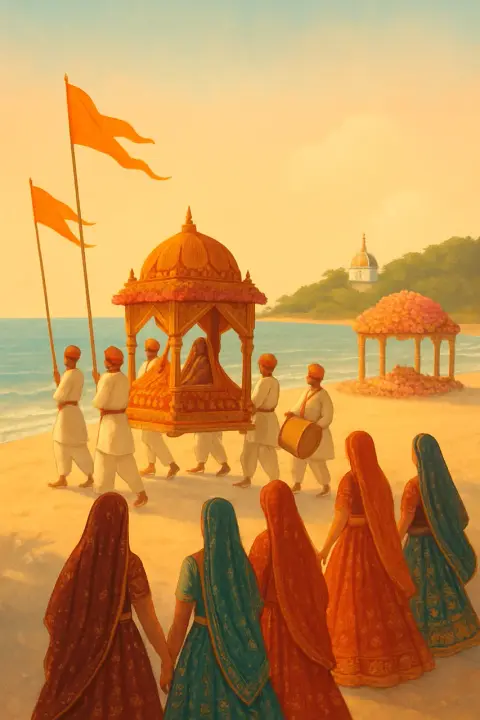
Madhavpur Ghed Fair: Krishna's wedding on the Saurashtra shore
A chariot carries a god to his wedding pavilion by the Arabian Sea
The Madhavpur Ghed Fair is a five-day fair in the seaside village of Madhavpur, near Porbandar in Gujarat, that celebrates the wedding of Krishna and Rukmini. It begins on Ram Navami in the month of Chaitra, and its high point is the fourth evening, when a chariot carries Krishna's image through the village to the wedding pavilion by the sea. Dates: 15–19 April 2027 (expected); Gujarat Tourism and the Porbandar collectorate announce the programme a few weeks ahead.
The days follow the lunar calendar; Gujarat Tourism and the Porbandar collectorate announce the programme a few weeks ahead.
The legend
Local legend says Princess Rukmini wished to marry Krishna but her brother Rukmi refused. Krishna carried her away and married her here at Madhavpur.
Madhav, "honey-like", is a name of Krishna, so Madhavpur is "Madhav's town". Ghed comes from the word for pot: the coastal hollow fills with monsoon water.

The wedding is remembered at the Madhavrai temple; the present one was built in 1840 by Rupaniba, Queen of Porbandar, beside the ruins of the old.
Customs
Wedding rites
From Ram Navami the wedding plays out over five days: the mandap canopy goes up, the evening Fuleku procession follows, then the Mameru rite with the bride's kin.
Groom on a chariot
The great procession takes Krishna's image by chariot through the village to the wedding pavilion by the sea.
North-East guests
On the fair stage troupes from Arunachal, Assam and Manipur dance beside Gujarati artists: Rukmini is linked with Arunachal.
Where to celebrate
Madhavpur
Follow Krishna's wedding to Rukmini in a Saurashtra seaside village: evening processions, the chariot to the wedding pavilion on the fourth evening, and North-Eastern troupes on the fair stage.
Five days of a wedding
The fair runs from the ninth to the thirteenth lunar day of the bright half of Chaitra; it is free to watch.
- Day 1, Ram Navami: the mandap goes up
The rites begin at the Madhavrai temple with Mandap Ropan, the raising of the wedding canopy.
- The first evenings: Fuleku processions
Evening processions go from the temple through the village lanes to the Brahma Kund tank. The Mameru rite with the bride's kin follows.
- Day 4: the groom's chariot
In the afternoon the wedding party sets out, and by evening the chariot carrying Madhavrai reaches the wedding pavilion by the sea. The wedding ceremony goes on through the night.
- Every day: the fairground
On the stage by the beach troupes from Arunachal Pradesh, Assam and Manipur perform beside Gujarati artists, including Assam's Rukmini-Haran folk theatre. Craft and food stalls and beach games fill the ground; recent fairs have added a beach sports programme.
The legend and the temple
By local legend, Princess Rukmini, daughter of King Bhishmaka, wished to marry Krishna, but her brother Rukmi refused; Krishna carried her away and married her here. The name keeps the story: Madhav is a name of Krishna, so Madhavpur is Madhav's town, while ghed comes from the word for a pot, after the coastal hollow that fills with monsoon water.
The wedding is remembered at the temple of Madhavrai, Krishna as the bridegroom. The Porbandar district administration dates the temple to the 15th century; the old building was damaged and its ruins still stand, and the present temple beside them was built in 1840 by Rupaniba, Queen of Porbandar.
The North-East link comes from the same story. By a tradition in Arunachal Pradesh, Bhishmaka ruled at Bhismaknagar near Roing, and some of the Idu Mishmi trace their ancestry through him to Rukmini; the link is debated in Arunachal itself, and the Bhismaknagar ruins are dated to between the 11th and 15th centuries and linked with the Chutia kingdom. The fair now brings performers from the North-Eastern states under the Ek Bharat Shreshtha Bharat programme.
How to reach Madhavpur
Porbandar, about 60 km away, is the base.
- Train: Porbandar station has trains to Rajkot, Ahmedabad and Mumbai. Keshod station is about 39 km from Madhavpur.
- Air: Porbandar has a domestic airport with a flight to Mumbai; Keshod also has an airport.
- Bus: GSRTC and private buses run from Ahmedabad, Rajkot, Dwarka, Veraval, Jamnagar and Junagadh.
The fair is an easy detour on a trip to Porbandar, Dwarka or Somnath.
Planning the trip
The fair is free; what needs booking is the bed and the train.
- Stay in Porbandar — Book about a month ahead. Madhavpur itself has only a few small guesthouses by the beach.
- Book the train early too — Trains to Porbandar are worth booking about a month ahead.
- Arrive a day ahead — Come the day before the wedding evening and stay in Porbandar.
- Where to watch — The village lanes for the evening processions, the road to the sea on the fourth evening, and the fairground stage for the North-Eastern and Gujarati troupes.
FAQ
In which Indian state is the Madhavpur Mela celebrated?
In Gujarat, at the coastal village of Madhavpur Ghed in Porbandar district, about 60 km from Porbandar.
Which marriage is celebrated at Madhavpur?
The wedding of Krishna and Rukmini. By local legend, Krishna carried Rukmini away and married her here.
When is the Madhavpur Ghed Fair?
Next: 15–19 April 2027 (expected). Five days from Ram Navami in Chaitra, usually between late March and late April; the chariot procession to the sea is on the fourth evening.
Why is the North-East part of the Madhavpur fair?
By a tradition in Arunachal Pradesh, Rukmini's father Bhishmaka ruled at Bhismaknagar near Roing, and some Idu Mishmi trace their ancestry to her; the link is debated. Troupes from Arunachal, Assam and Manipur perform at the fair.
Is there an entry fee?
No, the fair and the processions are free to watch.
Sources (8)
Facts checked: 22 October 2026. Prices and hours are approximate; check locally.