 India GO
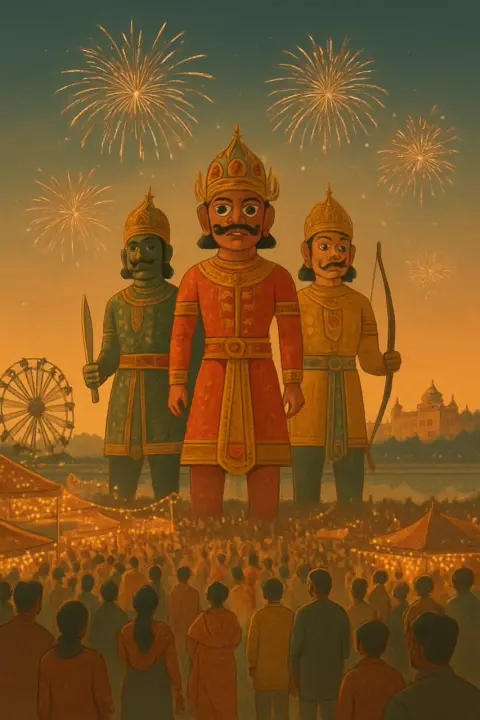
Kota Dussehra Mela: Ravana's giant effigies and a three-week fair
A ten-headed giant goes up in flames and the fairground sky fills with sparks
The Kota Dussehra Mela, officially the National Dussehra Fair, is held on the Dussehra Maidan in central Kota, Rajasthan. Its peak is Vijayadashami evening, when giant firework-packed effigies of Ravana, Kumbhakarna and Meghnath are set alight; the fair then runs on for more than two weeks. Dates in the Rajasthan Tourism calendar: 20 October – 6 November 2026. The fairground itself opens with Navratri, about ten days earlier.
Rajasthan Tourism publishes the dates years ahead (its current list runs to 2030) and can revise them; check its calendar a few months before.
The legend
Dussehra, the "tenth day", marks Rama's victory over Ravana in the great battle, the triumph of good over evil.
Kota's fair dates back to 1723 and the reign of Maharao Durjansal Singh Hada; later rulers added processions and performances.
Today it is the National Dussehra Fair: from Navratri into November the Dussehra Maidan hosts Ramleela, concerts and market rows.
Customs
Ramleela
Every evening of Navratri the Ramleela is staged, and the audience chants Rama's name during the show.
Burning Ravana
On Vijayadashami giant effigies of ten-headed Ravana, Kumbhakarna and Meghnad, packed with fireworks, are set alight.
Village processions
People from the surrounding villages come in colourful dress, in long processions, to offer prayers to Rama.
Where to celebrate
Kota
Kota's National Dussehra Mela (the 132nd in 2025) burns giant effigies of Ravana and his kin on Vijayadashami, then keeps its fairground and concert stage going for two more weeks.
How the fair runs
Dussehra, the 'tenth day', marks Rama's victory over Ravana, and Kota builds its whole autumn around it. The fairground opens with Navratri. Every evening of Navratri the Ramleela, the staged story of Rama, is performed on the Shri Ram Rangmanch, and Rajasthan Tourism notes that the audience chants Rama's name during the show. Villagers from the surrounding area arrive in long processions in colourful dress to offer prayers to Rama.
On Vijayadashami evening the royal procession of Lord Laxminarayan sets out from the Garh Palace, Kota's old palace, for the Dussehra Maidan, where the effigies are burnt. The palace also hosts the Darikhana, a formal court gathering in traditional dress and turbans, hosted by the former royal family.
After Dussehra the fair carries on: market rows across the Maidan and evening concerts that move to the Vijay Shri Rangmanch stage. The ground is entered through numbered gates.
The effigies
The effigies of ten-headed Ravana, his brother Kumbhakarna and his son Meghnath are stuffed with fireworks and burst as they burn. Rajasthan Tourism describes them as 75 feet tall, but recent Ravanas have been built far bigger: ETV Bharat reported a Ravana of 221 feet. Watching the burning is free: people stand on the open ground of the Maidan, outside the safety cordon. For more on the festival itself, see Dussehra.
Three centuries of Dussehra in Kota
According to the fair's official website, religious events for Dussehra began in Kota under Maharao Durjanshal Singh (1723–1756). Maharao Umed Singh II gave the fair an organised form in 1892–93: at first it lasted three days, with small shops under tarpaulins, and grew to seven. In 1921 the newly founded municipality took over, and traders from other states began to be invited. Today the fair runs for about three weeks.
Plan your visit
Kota is a large city and the Maidan is central, so stay in town.
- Book a room a month ahead
Kota's hotels fill for the effigy night.
- Book trains when sales open
Kota Junction is on the Delhi–Mumbai main line, and Dussehra opens the busiest travel season of the year. Book on the day reservations open, 60 days before departure.
- Arrive the day before
One night after the burning is the minimum; arriving a day earlier lets you see the last episodes of the Ramleela.
- Keep outside the cordon
Come early for a place, stay behind the safety cordon while the fireworks go off, and follow police instructions. FCDO notes that stampedes have occurred during events with large crowds in India.
- Confirm the dates
Rajasthan Tourism publishes the dates years ahead but can revise them; check its calendar a few months before.
FAQ
When is the Kota Dussehra Mela?
In the Rajasthan Tourism calendar: 20 October – 6 November 2026, starting on Vijayadashami, the night of the effigy burning. The fairground and the Ramleela open with Navratri, about ten days earlier.
What is Kota Dussehra?
Kota's National Dussehra Fair, held on the Dussehra Maidan for about three weeks around Dussehra, with nightly Ramleela, a royal procession from the Garh Palace and the burning of giant effigies of Ravana and his kin.
Is there a ticket for the effigy burning?
No. The burning is watched standing on the open ground of the Dussehra Maidan, outside the safety cordon. Come early.
How old is the Kota Dussehra fair?
Religious events for Dussehra began under Maharao Durjanshal Singh (1723–1756); the organised fair dates from 1892–93.
How tall is the Ravana effigy in Kota?
It changes every year. Rajasthan Tourism speaks of 75-foot effigies, while recent Ravanas have been far taller: ETV Bharat reported one of 221 feet.
What else is near Kota?
The fair pairs well with Bundi and Jhalawar, and with the Chandrabhaga Fair.
Sources (6)
- Rajasthan Tourism: fairs and festivals, Dussehra Fair Kota
- Rajasthan Tourism: Fairs and Festivals 2024–2030 (PDF)
- Kota Dussehra Mela: official website (about)
- ETV Bharat: 221-feet Ravan effigy in Kota
- FCDO: India, safety and security
- Onmanorama: Indian Railways reduces advance reservation period from 120 to 60 days (Railway Board notification)
Facts checked: 21 October 2026. Prices and hours are approximate; check locally.