 India GO
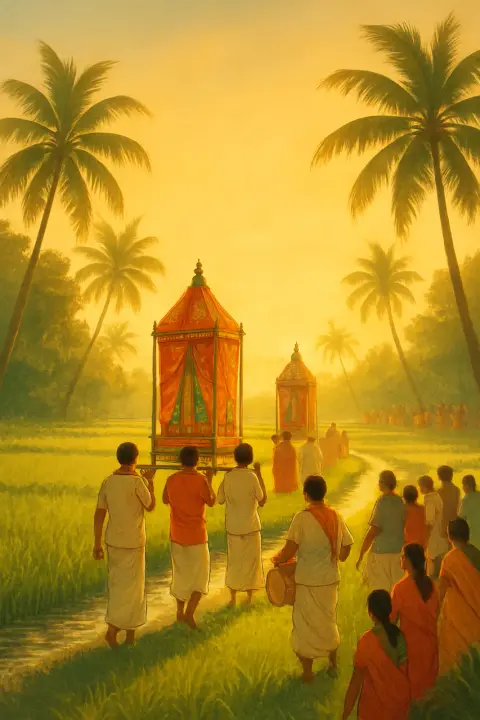
Prabhala Teertham: Shiva's towers cross the rice fields of Konaseema
Village gods on bamboo towers wading waist-deep across the canals
Prabhala Teertham is held once a year on Kanuma, the third day of Sankranti, at Jaggannathota near Ambajipeta in the Konaseema delta of Andhra Pradesh. Men from eleven villages with Rudra temples carry prabhalu, towering bamboo frames that each stand for Shiva, on their shoulders through paddy fields and canals to a coconut grove with no temple and no idol. Next date: 16 January 2027 (expected). The tradition is about four centuries old, and Andhra Pradesh has recognised it as a state festival.
The Andhra Pradesh holiday list, issued in early December for the next year, fixes Kanuma.
The legend
Legend says that on Kanuma in the 17th century the eleven forms of Shiva, the Ekadasa Rudras, met at Jaggannathota to counsel on the good of the world.
For some four centuries since, eleven villages with Rudra temples have carried their Shivas on prabhas to Jaggannathota, a coconut grove in the Godavari delta.
Customs
Prabhas on shoulders
A prabha is a tall frame of bamboo and coloured cloth weighing hundreds of kilos, carried on men's shoulders from the village to the shared field.
Wading the canals
The route runs straight through flooded paddy and canals, waist-deep, while the district gathers on the banks of the Kowsika.
Where to celebrate
Amalapuram
On Kanuma, the third day of Sankranti, eleven villages carry towering prabhas of Shiva's Ekadasa Rudras through the paddy and across the Kowsika to Jaggannathota, a coconut grove with no temple.
What a prabha is and what you see
A prabha (plural prabhalu) is a tall frame of bamboo and coloured cloth weighing hundreds of kilos, built in each village and taken out after special pujas in its temples. The largest rise to about 52 feet and spread 20 to 30 feet wide. Devotees believe each one is a symbolic form of Shiva, so carrying it is an act of devotion, and they walk barefoot from villages two to five kilometres away.
The route runs straight across the delta: through flooded paddy and canals, at times waist-deep, while the district gathers on the banks. By legend, on a Kanuma in the 17th century the Ekadasa Rudras, the eleven forms of Shiva, met at Jaggannathota to counsel on the good of the world, and that is why the eleven prabhas still converge on this one grove. Andhra Pradesh has also shown the festival on its Republic Day tableau.
Where to watch
Everything is free and in the open. The prabhas set off in the morning, so choose between a departure and the arrival.
Jaggannathota, Mosalapalli (Ambajipeta mandal)
The meeting ground, roughly 10 km from Amalapuram by road. Watch from the fields and bunds as the prabhas arrive.
The Kowsika crossing at Gangalakurru Agraharam
The prabhas of Gangalakurru and Gangalakurru Agraharam are carried across the Kowsika river; the Agraharam prabha, of Sri Veereswara Swamy, crosses last. Watch from the bank, not from the water.
Vyaghreswaram
Home of the chief prabha of the eleven Rudras, about 15 km from Amalapuram: here you can see it leave the temple street in the morning.
Where to stay and when to book
Sankranti is the biggest homecoming of the year in the Godavari districts, and that is the real difficulty of this trip.
- Base: Amalapuram or Rajahmundry
The villages have no lodgings. Amalapuram is closest; Rajahmundry has more hotels but is further.
- Book about a month ahead
Amalapuram's lodges and Rajahmundry's hotels fill with families coming home for Sankranti. Book trains from Hyderabad as soon as reservations open, 60 days ahead.
- Go early, with wet feet in mind
Arrive the day before and set out early on Kanuma morning, ideally with a car. Wear footwear you do not mind getting muddy.
Etiquette and safety
This is a procession of devotion, not a parade, and the bearers do not set the prabhas down along the way.
- Keep out of the path — A prabha weighs hundreds of kilos and moves with the crowd around it. Stand back on the bunds and never cut in front of the bearers.
- Stay on the bank — The canal and river crossings are for the bearers. Watch from dry ground.
- Follow the officials — The revenue and endowments departments make the arrangements on the day; follow police and volunteers. For general advice see is India safe.
Part of Sankranti
Kanuma is the last day of the Telugu Sankranti, after Bhogi and Makar Sankranti, the day Andhra Pradesh fixes in its holiday list each December. Shiva's other great nights are on the Shiva page; in a Pushkaram year, the Godavari Pushkaralu is the delta's other big gathering.
FAQ
What is Prabhalu?
Prabhalu (singular prabha) are tall frames of bamboo and coloured cloth, each believed to be a form of Shiva, carried on men's shoulders from eleven villages to Jaggannathota on Kanuma.
When is Prabhala Teertham?
On Kanuma, the third day of Sankranti: next, 16 January 2027 (expected). The Andhra Pradesh holiday list, issued in early December, fixes the day.
Where is Jaggannathota?
In Mosalapalli village, Ambajipeta mandal, Konaseema district, roughly 10 km from Amalapuram. It is a coconut grove with no temple or idol of its own.
How old is Prabhala Teertham?
About four centuries. By legend the eleven Rudras first met at Jaggannathota on a Kanuma in the 17th century.
How do I get to Prabhala Teertham?
Stay in Amalapuram or Rajahmundry and go by road; Jaggannathota is roughly 10 km from Amalapuram.
Sources (5)
Facts checked: 22 October 2026. Prices and hours are approximate; check locally.