 India GO
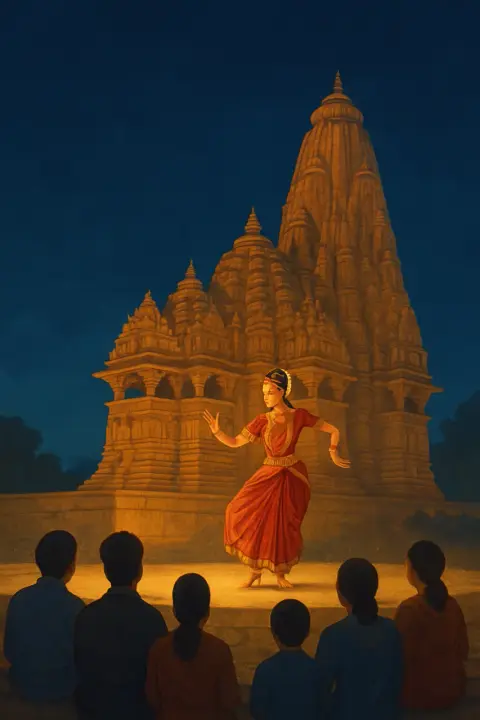
Khajuraho Dance Festival: classical dance in front of the temples
Dancers on a night stage beneath temple walls crowded with stone dancers
The Khajuraho Dance Festival is a week of Indian classical dance performed at night on an open-air stage by the western group of temples in Khajuraho, Madhya Pradesh, with the carved Chandela temples lit up behind the dancers. It has run every February since 1975 and entry is free. Dates: 20–26 February 2027 (expected); MP Tourism publishes each edition's dates on its events page in advance.
The dates are fixed by tradition; the Madhya Pradesh culture department and MP Tourism announce the edition in December or January.
The legend
The Chandela kings traced their line to the Moon: inscriptions call the first of them a descendant of the sage Chandratreya, son of the Moon.

Between 885 and 1000 they build temples by their capital, and by the 12th century there are 85.

Later the jungle closes over them, and about 25 survive today.
In 1975 living dance returns to the walls where stone dancers stand frozen: each spring, for a week, masters of classical dance perform here.
Meaning
Two faiths
The temples were built at the same time for Hindus and Digambara Jains, a sign of respect for each other's faith.
The stage
The dancing takes place in the open air before the Chitragupta temple to the Sun and the Vishvanatha temple to Shiva.
Customs
Seven styles
Masters of Kathak, Bharatanatyam, Odissi, Kuchipudi, Manipuri, Gaudiya Nritya and Kathakali take the stage.
Night stage
The dancing is in the evenings, with the temples lit up behind the performers, and it is free to watch.
A stone chorus
The temple walls are crowded with carved dancers, so the living dance unfolds against a dance in stone.
Words of the festival
खर्जूर
kharjura
"date palm": the root of the old name Kharjuravahaka and of today's Khajuraho
नाट्य शास्त्र
Natya Shastra
the treatise on the performing arts ascribed to the sage Bharata, in 36 chapters
रस
rasa
"juice, taste": the feeling a performance awakens in the audience
True or myth
❌ Myth. Such scenes make up less than a tenth of the sculpture and are not given prominence over the rest.
❌ Myth. The Briton T. S. Burt described them in 1838, but Cunningham reported that yogis worshipped there quietly and thousands of pilgrims came for Shivaratri.
✅ True. The first festival was held in 1975; the temples joined the World Heritage list in 1986.
Where to celebrate
Khajuraho
Worth the trip
Seven evenings of classical dance in late February on an open-air stage inside Khajuraho's western group of temples, free to watch, with the carved Chandela temples lit up behind the dancers.
What a festival evening looks like
Each evening the programme begins at dusk (at 18:30 at the last edition) and runs as a sequence of solo and group performances by leading dancers of the classical styles: Kathak, Bharatanatyam, Odissi, Kuchipudi, Manipuri, Gaudiya Nritya and Kathakali, with modern Indian dance added in recent editions. Any evening is worth it; the closing nights usually carry the most senior performers. The festival is organised by the Madhya Pradesh Kala Parishad, the state arts council.
The stage stands in the open air with the floodlit temples behind it. Its exact place has moved between editions: it has usually been set in front of the Chitragupta temple, dedicated to the Sun, and the Vishvanatha temple, dedicated to Shiva, and at the last edition it stood before the Kandariya Mahadeva and Jagadambi temples. The point is the same either way: the temple walls are crowded with carved dancers, so the living dance unfolds against a dance in stone.
Around the stage the festival has grown a daytime programme too. At the last edition it included a crafts bazaar (Hunar), regional food (Swad), talks with artists (Kalavarta) and rhythm workshops (Layshala), and a cultural rally through the town.
Why Khajuraho
The temples were built during the Chandela dynasty, which UNESCO says reached its apogee between 950 and 1050. Only about 20 temples remain; they fall into three distinct groups, western, eastern and southern, and belong to two religions, Hinduism and Jainism. In UNESCO's words all surfaces are profusely carved, with sacred and secular themes: acts of worship and deities, and scenes of social life such as domestic scenes, teachers and disciples, dancers and musicians, and couples. The temples joined the UNESCO World Heritage list in 1986, eleven years after the first dance festival was held in front of them.
How to plan the days
The festival fills the evenings and leaves the days free.
- Temples by day
The western group is open on ASI (Archaeological Survey of India) hours with an ASI ticket, bought online on the ASI portal or at the gate. The festival itself costs nothing.
- Dance by night
Come to the stage before the start; every one of the seven evening programmes is free.
- Two to four nights
Two nights is the minimum, four is better. Panna Tiger Reserve is 25 km away and Orchha 175 km, if you want to add a day out.
Getting there and booking
Khajuraho is a small, remote town, and festival week is its busiest of the year.
- Room: about two months ahead
Stay in Khajuraho village itself, within walking distance of the western group; the town fills for the festival and prices rise.
- Transport with the room
Book transport at the same time. The railway station is about 5 km from the town centre, and a Vande Bharat Express runs from Delhi (Hazrat Nizamuddin); check the current timetable on Indian Railways, and note that train tickets go on sale 60 days ahead. The airport is about 2 km from town, but flights are few.
- Arrive the day before
Khajuraho is remote and transport is thin, so arrive the day before the evening you most want to see.
FAQ
When is the Khajuraho Dance Festival?
Next: 20–26 February 2027 (expected). By tradition it runs for a week in the second half of February; MP Tourism publishes the dates in advance.
Is entry to the Khajuraho Dance Festival free?
Yes. MP Tourism lists entry to the festival as free for all evening programmes. Visiting the temples by day needs a separate ASI ticket.
Where is the Khajuraho Dance Festival held?
In Khajuraho, Chhatarpur district, Madhya Pradesh, on an open-air stage by the western group of temples.
Who started the Khajuraho Dance Festival?
The Government of Madhya Pradesh, which first held it in 1975; it is organised by the Madhya Pradesh Kala Parishad.
Which dance forms are performed at Khajuraho?
Kathak, Bharatanatyam, Odissi, Kuchipudi, Manipuri, Gaudiya Nritya and Kathakali, with modern Indian dance in recent editions.
Sources (4)
Facts checked: 21 October 2026. Prices and hours are approximate; check locally.