 India GO
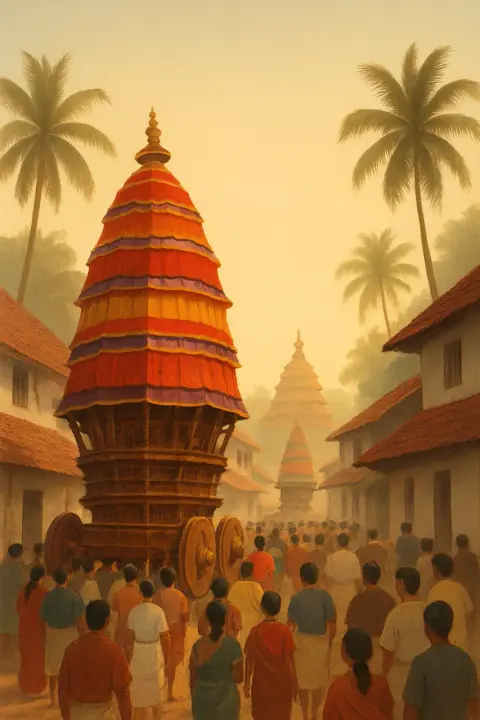
Kalpathi Ratholsavam: six chariots in a Palakkad agraharam
Wooden chariots edge through lanes built just wide enough for them
Kalpathi Ratholsavam is the chariot festival of the Sri Visalakshi Sametha Sri Viswanatha Swamy temple in Kalpathy, a Tamil Brahmin agraharam (a village of Brahmin row houses) on the edge of Palakkad in Kerala. It lasts ten days in the Malayalam month of Thulam, Aippasi in Tamil, and its climax is the last three days, when six wooden chariots are hauled by rope through the village lanes: 14–16 November 2026. On the final evening they all meet in front of the temple, the Devaratha Sangamam.
The chariot days fall on the last three days of Thulam, so they are known well ahead; Kerala Tourism lists them, and the flag goes up about a week before.
The legend
Ratholsavam is the chariot festival of Kalpathy, a Tamil Brahmin agraharam village in Palakkad, centred on the temple of Viswanatha, Shiva.
The tradition is believed to be over 700 years old. The festival runs ten days in November, the month of Thulam in Malayalam and Aippasi in Tamil.
Four temples of Kalpathy and Chathapuram take part with six chariots; three belong to the Viswanatha temple, for Shiva with Parvati, Ganesha and Murugan.
Customs
Gods on vahanas
In the early days the deities are dressed in different forms, on Garuda, Hanuman or Ganesha's mouse, and carried through the streets on bamboo poles or palanquins.
Pulling the chariots
On the last three days thousands haul the decorated chariots by rope through the agraharam lanes, calling on Shiva, Narayana and Hanuman.
Devaratha Sangamam
On the final day all the chariots meet before the Viswanatha temple, while a Carnatic music festival runs nearby.
Where to celebrate
Palakkad
For three November days six wooden chariots are hauled through the lanes of Kalpathy, the Tamil Brahmin agraharam of Palakkad, until they meet in front of the Viswanatha temple at dusk.
How the ten days run
The festival builds slowly. On the first four days the temple holds Vedic recitals and cultural programmes. In the evenings the deities, dressed in different forms, are carried through the streets on their vahanas (mounts), on bamboo poles or palanquins: Vishnu on Garuda or Hanuman, Ganesha on his mouse. On the fifth day, Anjaam Thirunaal, they ride in smaller chariots.
The big chariots come out only on the last three days, known as Onnam, Randam and Moonnam Theru, the first, second and third chariot days. Six chariots from four temples take part: the Viswanatha temple itself, the Lakshmi Narayana Perumal temple, the Manthakkara Mahaganapathy temple and the Chathapuram Prasanna Mahaganapathy temple. Three of them belong to Viswanatha: one for Shiva with Parvati, one for Ganesha and the smallest for Murugan. Thousands of devotees pull them by rope through the agraharam lanes, calling on Shiva, Narayana and Hanuman.
On the evening of the last day all six chariots are brought together in front of the Viswanatha temple, at the spot called Therumutty. This meeting of the chariots, the Devaratha Sangamam, is the moment the whole festival leads up to. Alongside it runs a Carnatic music festival on Mani Iyer Road in Chathapuram, with the Unchavritti and Pancharatna kirtana singing traditions, and roadside stalls sell food and clothes.
Kalpathy and its temple
Kalpathy, on the banks of the Kalpathy river, was the first heritage village declared in Kerala. It was settled by Brahmin families from Thanjavur, and four agraharams make it up: Chathapuram, Govindarajapuram, Old Kalpathy and New Kalpathy. Their gridded streets of row houses were laid out narrow, just wide enough for the chariots.
The Viswanatha temple is one of the oldest Shiva temples in Malabar, believed to be over 700 years old, and is said to resemble the Kashi Vishwanath temple of Varanasi: the deity is Viswanatha, a form of Shiva, with his consort Visalakshi, a form of Parvati. By Kerala Tourism's account the temple was once under the Akathethara kings of Palakkad, who invited Brahmins from Thanjavur to perform its rituals; with them came the Ratholsavam and its Carnatic music and Vedic traditions.
Where to watch
Everything happens in the public streets, with no tickets. Whether non-Hindus may enter the temple sanctums is for the temple to say: ask at the gate.
Agraharam lanes, last three days
The chariots edging through Old and New Kalpathy and Chathapuram, pulled by rope.
In front of the Viswanatha temple, final evening
The Devaratha Sangamam at dusk, the moment the festival leads up to.
The first evenings
The vahana processions of the early evenings, before the big chariots come out.
Mani Iyer Road, Chathapuram
The Carnatic music festival that runs during the festival.
Planning and getting there
- Check the dates
The chariot days fall on the last three days of Thulam, so they are known well ahead; the flag goes up about a week before. Kerala Tourism lists the dates; confirm them locally before you travel.
- Book about a month ahead
Book a room in Palakkad town and your trains about a month ahead. The processions need no tickets.
- Arrive the day before the first chariot day
One night, the Sangamam night, is the minimum; four nights cover the eve of the chariots through the final meeting.
- By train or air
Palakkad Junction, on the Chennai–Kochi main line, is about 3 km from Kalpathy, and Palakkad Town station about 2 km. The nearest airport is Coimbatore, about 55 km away; Kochi airport is about 110 km and Calicut about 100 km.
- Crowds
The FCDO notes that stampedes have occurred at religious gatherings with large crowds and advises following the advice of local authorities.
FAQ
When is Kalpathi Ratholsavam?
The chariot days: 14–16 November 2026. They are the last three days of the Malayalam month of Thulam, usually in mid-November, ending with the Devaratha Sangamam on the final evening.
Where is Kalpathi Ratholsavam celebrated?
In Kalpathy, a Tamil Brahmin heritage village on the Kalpathy river in Palakkad, Kerala, around the Sri Visalakshi Sametha Sri Viswanatha Swamy temple.
How far is the Kalpathy temple from Palakkad Junction?
About 3 km; Palakkad Town station is about 2 km away.
What is the origin of Kalpathi Ratholsavam?
It is the festival of the Tamil Brahmins who settled Kalpathy from Thanjavur, centred on a Shiva temple believed to be over 700 years old; the festival tradition itself is believed to be over 700 years old.
Is there an entry fee?
No. The processions and the chariot meeting take place in the public streets and are free; ask at the temple gate whether non-Hindus may enter the sanctums.
Sources (4)
Facts checked: 21 October 2026. Prices and hours are approximate; check locally.