 India GO
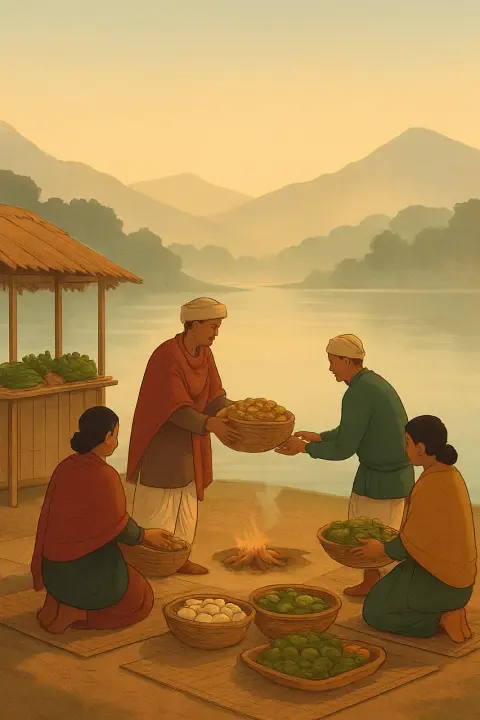
Jonbeel Mela: the fair where money has no use
Ginger traded for rice cakes on a lakeshore where money has no use
Jonbeel Mela is a three-day fair on the bank of the Jonbeel lake near Jagiroad in Morigaon district, Assam, held in the week after Magh Bihu. Hill communities and plains people meet there to exchange goods by barter, and the Gobha Raja, king of the Tiwa, comes with his court to collect a token tax. Next: 21–23 January 2027 (expected). The fair is free and open to all.
The mela committee and the Gobha king's darbar fix the dates and announce them in Morigaon in December or early January.
The legend
Jonbeel is Assamese for "moon wetland": the lake near Jagiroad is shaped like a crescent moon.
The fair dates back at least to the 15th century, begun by the Tiwa to discuss the affairs of the day. Its theme is still harmony of hill and plains peoples.
The Gobha Raja, king of the Tiwa, comes to the fair with his courtiers and collects a token tax from his subjects.
Customs
Trade without money
Tiwa, Karbi, Khasi and Jaintia people come down from the hills with ginger, turmeric and garlic and swap them with plains people for rice cakes.
Fire worship
Before the fair a fire worship is performed for the well-being of all people.
Community dances
The communities perform their own dances and music on the fairground.
Where to celebrate
Morigaon
Three days by the Jonbeel lake near Jagiroad, where hill and plains communities still trade by barter at dawn on day 2 and the Tiwa king holds court.
What Jonbeel Mela is
Jonbeel means "moon wetland" in Assamese: the lake near Jagiroad is shaped like a crescent moon. The fair dates back at least to the 15th century. By tradition it was begun by the Tiwa, also called Lalung, as a gathering to discuss the affairs of the day, and its theme is still the harmony of the hill and plains peoples.
What makes it known is that trade here does not use money. Tiwa, Karbi, Khasi and Jaintia people come down from the hills with ginger, turmeric and garlic and swap them with plains people for rice cakes and other goods. It is routinely described as the only fair in India where the barter system still works in practice.
The Gobha Raja, the customary king of the Tiwa, comes to the fair with his courtiers. He holds a royal court and collects a token tax from his subjects: a king with no state, still receiving tribute once a year.
How the three days run
The fair runs Thursday to Saturday. The order can shift slightly from year to year.
- Day 1: prayers at the Deosal
The fair opens at the Deosal shrine with prayers, a flag hoisting and a fire ritual, Agni Puja, for the well-being of all people, followed by a community feast with the Gobha Raja.
- Day 2: the barter morning
The barter ground fills from about 5 am, and the Gobha Raja holds his royal court the same day. This is the main day: 22 January 2027 (expected).
- Day 3: the king's tax
On the morning of the last day the Gobha Raja collects a token tax from the stalls.
- Fishing and dances
Community fishing on the lake falls on day 2 or 3, depending on the year, and the communities perform their own dances and music on the fairground.
Getting there and where to stay
The fairground is at Dayang Belguri, on the bank of the Jonbeel lake along the Jagiroad to Morigaon road, a few kilometres from Jagiroad. It is reached by road from Guwahati, about an hour and a half away, or from Jagiroad.
There is no real accommodation at the site. Most visitors stay in Guwahati and drive out early, or take a basic room in Jagiroad or Morigaon. Rooms are not the problem here: booking about three weeks ahead is enough, and trains and flights to Guwahati booked about a month ahead are usually fine. To see the barter at dawn on day 2, arrive the evening before or leave Guwahati before first light.
Etiquette at the fair
The whole fair is free and open. The barter ground at dawn on day 2 is the scene to see, but it is real trade between communities, not a show: stand back from the trading and ask before photographing anyone. Treat the prayers at the Deosal and the Gobha Raja's court with the same respect as any religious or royal ceremony. General advice on staying safe is on is India safe.
FAQ
Where is Jonbeel Mela celebrated?
At Dayang Belguri on the bank of the Jonbeel lake, near Jagiroad in Morigaon district, Assam, about an hour and a half by road from Guwahati.
When is Jonbeel Mela held?
Next: 21–23 January 2027 (expected). It runs for three days, Thursday to Saturday, in the week after Magh Bihu, usually in the second half of January. The mela committee and the Gobha Raja's darbar announce the dates in December or early January.
What is the history of Jonbeel Mela?
It dates back at least to the 15th century and, by tradition, was begun by the Tiwa as a gathering to discuss the affairs of the day. Its theme is harmony between hill and plains peoples.
What is traded at Jonbeel Mela?
Hill communities bring ginger, turmeric and garlic and exchange them with plains people for rice cakes and other goods, without money.
Who is the Gobha Raja?
The customary king of the Tiwa. He comes to the fair with his courtiers, holds court and collects a token tax from his subjects.
Sources (4)
Facts checked: 21 October 2026. Prices and hours are approximate; check locally.