 India GO
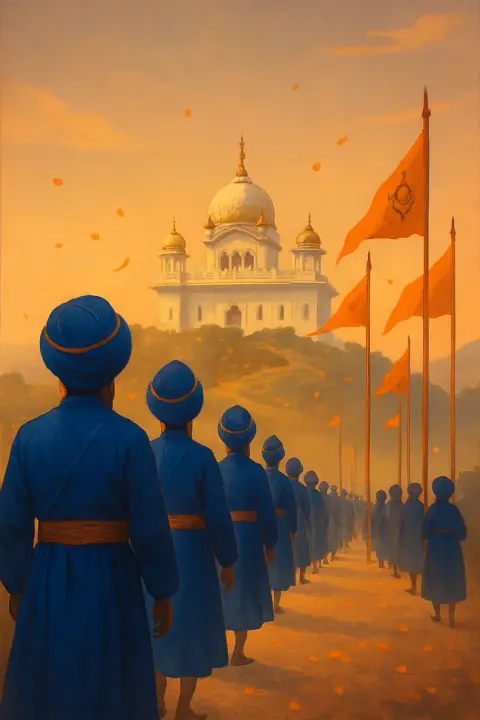
Hola Mohalla: the Sikh festival at Anandpur Sahib
Blue turbans, kettledrums and a langar that feeds everyone who comes
Hola Mohalla is the Sikh festival that Guru Gobind Singh began at Anandpur Sahib as a martial counterpart to Holi: three days of gatka, kirtan, Nihang camps and open langar, ending in a procession out of Takht Sri Kesgarh Sahib. At Anandpur Sahib it falls on 21–23 March 2027 (expected), on the first day of the lunar month of Chet, the day after the Holi colours or the same day.
The SGPC's Nanakshahi calendar and the Punjab holiday list, issued in December of the previous year, fix the day; the Rupnagar district administration announces the programme in February.
The legend

Hola Mohalla grew out of Holi, the spring festival the Sikhs kept alongside their neighbours.
The tenth Guru, Gobind Singh, gives the festival a martial spirit: on 22 February 1701 he leads the first procession with drums at Anandpur.

At Lohgarh Fort there are mock battles and poetry contests, and ever since the festival has fallen on the day after Holi.
Meaning
Anandpur Sahib
The "city of bliss", home of the last two Gurus and birthplace of the Khalsa in 1699; Kesgarh Sahib, third of the five Takhts, stands here.
Kiratpur Sahib
The custom of mock battles and poetry contests spread from Anandpur to nearby Kiratpur Sahib, the Shivalik foothills and gurdwaras around the world.
Customs
A week in camp
The fair lasts three days, but many camp for a week, watching displays of martial skill and listening to kirtan, music and poetry.
Pangat
Guests sit together in rows, pangats, and share the vegetarian food of the langar.
The army column
The final day ends with a long, military-style procession near Takht Kesgarh Sahib.
What people eat
Jalebi
batter spirals in syrup, the sweet of the festival days
Thandai
cold milk with rose water, nuts, saffron and spices
Words of the festival
ਹੋਲਾ-ਮਹੱਲਾ
Hola Mohalla
"the charge of an army": halla is a charge, mohalla a marching column
ਗੱਤਕਾ
gatka
the Sikh martial art of fighting with wooden sticks that stand in for swords
Nihang
a Sikh warrior order; the name is read as "sea monster" or "fearless"
How to greet
ਬੋਲੇ ਸੋ ਨਿਹਾਲ
Bole So Nihal!
"Whoever utters it shall be fulfilled": the cry given by Guru Gobind Singh, answered with "Sat Sri Akal!"
True or myth
❌ Myth. It falls on the day after Holi, and the Guru designed it as a display of martial training.
✅ True. The court poet Bhai Nand Lal wrote of rose water and saffron water being thrown.
✅ True. Every participant in the procession must carry a sword.
Where to celebrate
Anandpur Sahib
Worth the trip
Anandpur Sahib, where the Khalsa was founded, fills with Nihang camps, kirtan and round-the-clock langar for three days that end in the mohalla, a column marching out from Takht Sri Kesgarh Sahib.
Why Guru Gobind Singh began it
The SGPC, the body that manages the main Sikh shrines, writes that the tenth Guru, Gobind Singh, began Hola Mohalla at Anandpur Sahib, at the site of Qila Holgarh, on Chet vadi 1 of Samvat 1757, which falls in 1701 CE. In place of colour-throwing he set mock battles with swords, spears and lances, fought by infantry and cavalry from two sides, and gave a robe of honour, a siropa, to the winning side. The aim, in the SGPC’s words, was to build fearlessness and self-respect in the community.
The name is usually explained as “the charge of an army”: halla is a charge and mohalla an organised column (the explanation of the scholar Bhai Kahan Singh, given in encyclopedias). Colour did not vanish completely: the Guru’s court poet Bhai Nand Lal wrote of rose water and saffron water being thrown after the battles.
Anandpur Sahib, “the city of bliss”, is where the Khalsa was founded in 1699, at the place where Takht Sri Kesgarh Sahib stands, one of the five takhts of Sikhism. Hola Mohalla is the largest festival there today, and the custom spread to Kiratpur Sahib, the Shivalik foothills and gurdwaras around the world; the SGPC names Paonta Sahib and Hazur Sahib at Nanded among the big gatherings.
Where to watch at Anandpur Sahib
The festival opens a few days earlier at Kiratpur Sahib, about 10 km away, and then moves to Anandpur Sahib for its last days. Everything is free.
Takht Sri Kesgarh Sahib
The heart of the festival: diwans and kirtan through the days, and on the last day the mohalla procession sets out from here, a column of Nihangs with weapons and banners.
Charan Ganga Stadium
The open ground at the edge of town where the Nihang orders show gatka, the Sikh art of fighting with wooden sticks in place of swords, and mock combat, behind barricades.
Gurdwara Holgarh Sahib
On the site of Qila Holgarh, about 1.5 km northwest across the Charan Ganga stream, where the first Hola Mohalla was held.
The langar
Round-the-clock community kitchens in the gurdwaras and camps: guests sit together in rows, pangats, and share lacto-vegetarian food, whatever their faith.
Etiquette and safety
Hola Mohalla is a religious gathering of several hundred thousand people in a small town, and visitors of every faith are welcome.
- Cover your head — Kirtan and langar in the gurdwaras are open to everyone who covers their head. The UK Foreign Office (FCDO) asks visitors to respect local dress codes at religious sites.
- Give the displays room — The Nihang displays include horsemanship and weapons, and the procession marches with arms and banners. Watch from behind the barricades and step aside for the column.
- In the crowd — The FCDO notes that stampedes have occurred at some events with large crowds and advises following the local authorities. Agree a meeting point. Emergency number: 112.
Where to stay and when to arrive
Anandpur Sahib is small and has few hotels, so plan about six weeks ahead.
- Gurdwara sarais or a nearby city
The gurdwara sarais house pilgrims free, as part of the institution rather than as a budget option, but they fill first; the state has also set up a tent city. Hotels are in Rupnagar and Chandigarh, 40–90 km away.
- Trains on day one
Book trains as soon as sales open, 60 days out: the festival falls in Holi week.
- Arrive two days early
The procession is on the last day. Two nights is the minimum and three are better; many pilgrims camp for a week.
FAQ
When is Hola Mohalla?
At Anandpur Sahib: 21–23 March 2027 (expected). It falls on Chet vadi 1, the first day of the lunar month of Chet, the day after the Holi colours or the same day. The SGPC calendar and the Punjab holiday list fix it each year.
What is the difference between Holi and Hola Mohalla?
Holi is the spring festival of colours. Hola Mohalla, which follows it, was set by Guru Gobind Singh as a display of martial skill, with mock battles, gatka and a procession, plus kirtan and langar.
Why do we celebrate Hola Mohalla?
To keep the martial tradition Guru Gobind Singh began at Anandpur Sahib in 1701, which the SGPC describes as building fearlessness and self-respect.
What is the story of Anandpur Sahib?
Anandpur Sahib, “the city of bliss”, was home to the last two Gurus, and the Khalsa was founded there in 1699, where Takht Sri Kesgarh Sahib now stands.
Is Hola Mohalla the Sikh name for Holi?
No. It falls next to Holi and grew out of it, but it is a separate festival with a martial meaning. For Holi itself see Holi.
Sources (7)
- SGPC: Khalse da Hola Mohalla (Punjabi)
- SGPC: Historical Qilas
- Hola Mohalla (Wikipedia)
- FCDO travel advice for India: safety and security
- SGPC: Takhat Sri Keshgarh Sahib, Sri Anandpur Sahib
- Gurdwara (Wikipedia): langar open to all, lacto-vegetarian
- Hola Mohalla 2026: 5-day annual festival in Anandpur Sahib (The Tribune)
Facts checked: 21 October 2026. Prices and hours are approximate; check locally.