 India GO
Gita Jayanti and the International Gita Mahotsav in Kurukshetra
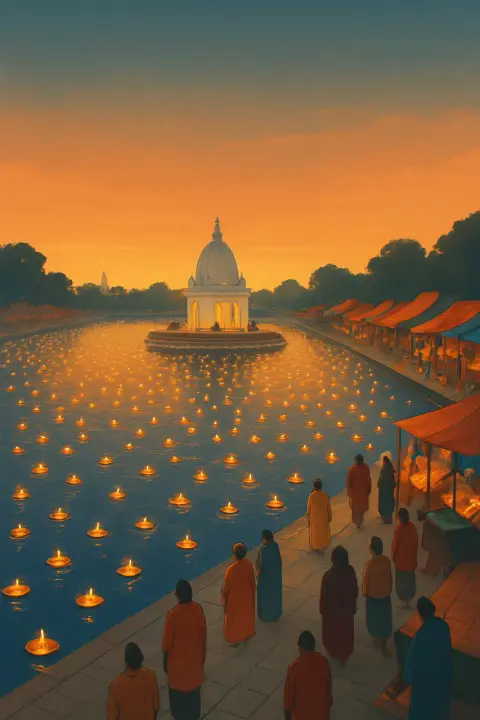
Lamps adrift at dusk on a vast tank in the land where Krishna counselled Arjuna
Gita Jayanti marks the day on which, by tradition, Krishna spoke the Bhagavad Gita to Arjuna on the battlefield of Kurukshetra. It falls on Mokshada Ekadashi, the eleventh lunar day of the bright half of Margashirsha, so it moves between late November and December. In Kurukshetra the Haryana government builds the International Gita Mahotsav around it: a crafts fair on the banks of Brahma Sarovar, stage programmes and, on the main evening, the Maha Aarti with lamps floated on the tank. Dates: 13–20 December 2026 (expected).
Gita Jayanti follows the lunar calendar; the Kurukshetra Development Board and Haryana Tourism announce the festival window around October.
The legend
In the Mahabharata two armies of kinsmen, the Pandavas and the Kauravas, face each other on the field of Kurukshetra.
Before the battle Arjuna asks Krishna, his charioteer, to drive him between the armies, and sees relatives, teachers and friends opposite.

Arjuna is torn, and Krishna counsels him on duty and the paths to liberation. That conversation is the Bhagavad Gita.

Tradition says Krishna spoke beneath a banyan at Jyotisar. In the 8th century Adi Shankara named it as the place where the Gita was spoken.

The Gita's day falls on Mokshada Ekadashi. Haryana has celebrated it at Kurukshetra since 1989, and since 2016 as the International Gita Mahotsav.
Customs
Lamps on the water
On the main evening Brahma Sarovar holds the deepdan: lamps are floated on the water while aarti is performed along the banks.
Crafts fair
More than three hundred stalls of craftspeople from across India and abroad go up around Brahma Sarovar.
Reciting the Gita
Thousands of schoolchildren recite the Gita together, and the town hosts the Gita Shobha Yatra procession and talks on the Gita.
The 48-kos circuit
Pilgrims walk the 48-kos circuit of Kurukshetra's holy sites, 134 tirthas in all.
Show on the water
In the evenings a water laser show plays on Brahma Sarovar, and artists from across the country perform on stage.
Words of the festival
गीता
Gita
"song"; the short name of the Bhagavad Gita
श्लोक
shloka
a verse of sacred text; the Gita has seven hundred in eighteen chapters
ब्रह्मसरोवर
Brahma Sarovar
"Brahma's lake": the vast tank at the heart of the festival
ज्योतिसर
Jyotisar
"the essence of light": where, by tradition, the Gita was spoken
मोक्षदा एकादशी
Mokshada Ekadashi
the "liberation-giving" 11th lunar day of Margashirsha, the Gita's day
दीपदान
deepdan
"gift of light": lamps set afloat on the water
True or myth
❌ Myth. It is a lunar day, the bright Ekadashi of Margashirsha, so the festival moves between late November and December.
✅ True. By one version of the Mahabharata, Krishna speaks 574 of the 700 verses and Arjuna 84.
✅ True. The tank, some 1,100 metres long, appears in his Kitab al-Hind.
Where to celebrate
Kurukshetra
For two to three weeks the state's Gita festival fills the banks of Brahma Sarovar with craft stalls and stages; on Gita Jayanti it culminates in the evening Maha Aarti and lamps floated on the tank.
What happens at the festival
The centre of everything is Brahma Sarovar in Thanesar, a sacred tank about 1.1 km long that the 11th-century scholar Al-Biruni already mentioned. For the festival more than 300 stalls of craftspeople from across India and abroad go up around its banks, alongside the Saras fair of rural producers, and in a recent edition the fairs ran on for several days after the main day.
In the evenings there are stage performances by artists from across the country and a water laser show on the tank. Thousands of schoolchildren recite the Gita together; in a recent edition 21,000 students did so at Keshav Park. The town also holds the Gita Shobha Yatra procession and talks on the Gita.
The peak is the evening of Gita Jayanti itself. In a recent edition the Chief Minister of Haryana led the Maha Aarti on the banks of Brahma Sarovar, and the deepdan follows: lamps set afloat on the water. At Sannihit Sarovar, the town's second sacred tank, thousands of earthen lamps are lit along the banks for the Deepotsav.
Where to go in Kurukshetra
The banks of Brahma Sarovar and the craft stalls are free to walk. On the main evening come early to find a place on the steps.
Brahma Sarovar, Thanesar
The heart of the festival: the crafts and Saras fairs, the daily Maha Aarti and the deepdan on Gita Jayanti.
Sannihit Sarovar
The second sacred tank, lined with earthen lamps for the Deepotsav.
Jyotisar
About 5 km out on the Pehowa road, where by tradition Krishna spoke the Gita beneath a banyan; a banyan held to be an offshoot of that tree stands on a raised plinth. In the 8th century Adi Shankara named Jyotisar as the place. There is a havan and recitation on the main day, a daily light and sound show on the lake and the Mahabharata-themed Anubhav Kendra museum.
Keshav Park
The ground for the mass recitation of the Gita on the main day.
From a local festival to an international one
The Bhagavad Gita, 700 verses in 18 chapters, is part of the Mahabharata: before the battle between the Pandavas and the Kauravas, Arjuna asks Krishna, his charioteer, to drive him between the armies, sees relatives and teachers on the other side and loses heart. Krishna's counsel on duty and the paths to liberation is the Gita.
Haryana has celebrated Gita Jayanti at Kurukshetra since 1989, and since 2016 as the International Gita Mahotsav. The length of the festival changes from year to year: the first international edition ran five days, others from about nine days to nearly three weeks. The Kurukshetra Development Board and Haryana Tourism announce each year's programme, usually in the autumn. Pilgrims also use the festival to walk the 48-kos circuit of Kurukshetra's holy sites, 134 tirthas in all.
Planning from Delhi
Kurukshetra is about 160 km from Delhi on the Grand Trunk Road. Allow at least two nights for the main day and the evening deepdan; a third gives time for Jyotisar and the fair.
- Book a room a month ahead
Rooms in Kurukshetra are limited. Karnal, 40 km towards Delhi, has more hotels.
- Take the train
Kurukshetra is on the main line from Delhi to Ambala, and trains from Delhi are frequent. For the main day book about a month ahead.
- Allow for fog
In December fog can delay trains and road traffic, so arrive the day before the main day and do not plan a tight connection that evening.
Crowds on the main evening
The banks of Brahma Sarovar are at their fullest for the Maha Aarti and the deepdan. The UK Foreign Office notes that stampedes at some events with large crowds in India have caused deaths and injuries, and advises avoiding large gatherings, including at religious sites. If you go, follow the instructions of the police and organisers. More in our guide Is India safe.
FAQ
When is Gita Jayanti?
Gita Jayanti falls on Mokshada Ekadashi in Margashirsha. The Kurukshetra festival: 13–20 December 2026 (expected), with the main day 20 December 2026 (expected). The festival window is a projection until Haryana announces the programme.
Why is Gita Jayanti celebrated?
It marks the day on which, by tradition, Krishna spoke the Bhagavad Gita to Arjuna at Kurukshetra before the Mahabharata battle.
Is Gita Jayanti on the same date every year?
No. It is a lunar day, so it moves between late November and December.
Do you need a ticket for the Gita Mahotsav?
No. The banks of Brahma Sarovar, the Maha Aarti, the deepdan and the craft stalls are free.
How do I get to Kurukshetra from Delhi?
By train on the Delhi to Ambala main line, or by road along the Grand Trunk Road, about 160 km.
Where did Krishna speak the Gita?
By tradition at Jyotisar, about 5 km from Kurukshetra town, beneath a banyan tree. Adi Shankara identified the place in the 8th century.
Sources (6)
Facts checked: 21 October 2026. Prices and hours are approximate; check locally.