 India GO
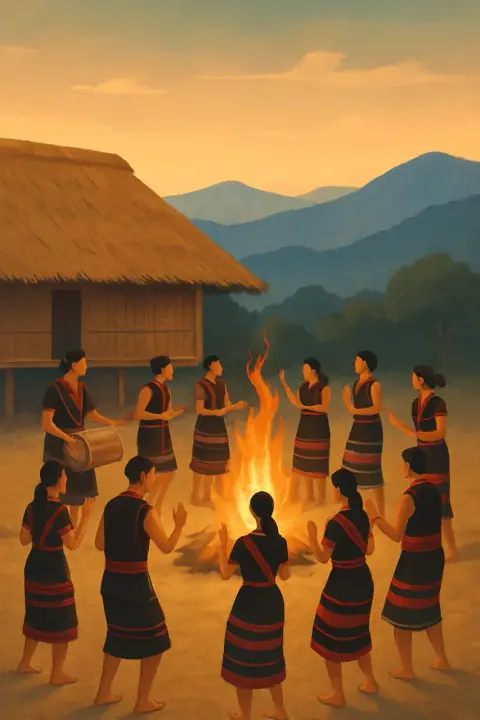
Gaan-Ngai: the Zeliangrong winter festival of new fire
Five winter days in the hills, each one danced by a different part of the village
Gaan-Ngai, "winter festival" in Ruanglat, is the five-day post-harvest festival of the Zeliangrong peoples (Zeme, Liangmai and Rongmei), who thank the supreme god Tingkao Ragwang for the harvest and welcome the new year. It is also a festival of light, remembering the coming of fire. Manipur's Department of Tribal Affairs and Hills places it in the month of Wakching (December to January); next: 20–24 January 2027 (expected). It is kept in the villages of Tamenglong district and in the Rongmei neighbourhoods of Imphal. Note before planning: the UK FCDO advises against all but essential travel to Manipur.
The Manipur government's holiday notification, usually published late in the previous year, fixes the day; village committees announce their programmes in the week before.
The legend
Gaan-Ngai means winter festival: the Zeliangrong thank the supreme god Tingkao Ragwang for the harvest and welcome the new year.
Legend says that when cooked rice stopped growing on the plants, people prayed until smoke rose from the ground: a fire in an earthen pot to cook rice.

So Gaan-Ngai is a festival of light, honouring the coming of fire and the victory of light over evil.
Customs
New fire
On the first evening young men make new fire with bamboo or flint and carry it from house to house, wishing everyone health and peace.
A dance for each day
Each day has its dance: on the second the girls dance, on the third a dance honours newcomers admitted to the youth dormitories.
Ginger at the edges
On the first day pieces of ginger, held to be Tingkao Ragwang's fingers, are thrown at the village edges to ward off evil.
FCDO advice and permits for Manipur
Gaan-Ngai is mainly a Manipur festival, and Manipur is under a specific UK travel warning. The FCDO's India advice says, word for word:
"FCDO advises against all but essential travel to the state of Manipur including the capital, Imphal. Curfews and restrictions continue in parts of Manipur following ongoing ethnic violence since May 2023."
Its regional risks page adds:
"There may be curfews and other restrictions including transport disruptions and the suspension of internet services at short notice in some parts of the state."
>
"Some insurgent groups are active in north-east India including in the state of Manipur."
and advises that you should "avoid protests or large gatherings", "follow the advice of the local authorities and your travel company" and "monitor local media and follow any curfew restrictions". It also warns: "Your travel insurance could be invalidated if you travel against advice from the Foreign, Commonwealth & Development Office (FCDO)." Read the current FCDO page and your own government's advice before deciding.
Foreign nationals. Press reports say the Ministry of Home Affairs reimposed the Protected Area regime on Manipur, so foreigners need a Protected Area Permit; no current official notice could be found. Check with an Indian mission, the Bureau of Immigration or a registered tour operator. The FCDO's general rule for protected areas is to apply about three months before arrival. See also our India visa guide.
Indian nationals. Indian citizens from outside Manipur need an Inner Line Permit, issued on the official ILP portal.
In an emergency anywhere in India, call 112. More in Is India safe?
The five days of Gaan-Ngai
The festival opens with a religious ceremony and congregational prayers to Tingkao Ragwang, who is offered the first taste of the food and drink prepared for the festival. The rest of the days, in the words of Manipur's tribal affairs department, are "associated with common feasts, dances, and presentation of gifts".
Day 1. In the Gucheng Phaimei ritual, pieces of ginger, held to be the fingers of Tingkao Ragwang, are thrown at the edges of the village to ward off evil. Village elders read omens for the coming year, a feast follows, and in the afternoon a ceremonial march leads to the ground where the young people compete in races and stone throwing. Winners pay a small fee, called shon, in acknowledgement of their strength rather than receiving a prize. In the evening the young men of the dormitory make new fire with bamboo or flint and carry it from house to house, wishing everyone health and peace.
Day 2. The girls dance the Tamchan lam, and meat, drinks and food are shared.
Day 3. The Tuna Gaan lam honours newcomers admitted to the youth dormitories and those promoted within them, and pays tribute to the dead.
Day 4. The unmarried gather and share meat, salt, chilli and rice beer, a pledge to keep good character for the soul's journey after death.
Day 5. Rituals and offerings are made to the eight brother gods.
Through the festival, families also honour those who died in the past year: graves are decorated with flowers, and food is offered so that their souls can reach Taroilam, the world after death.
The story of the coming of fire
Zeliangrong legend tells that rice once grew already cooked on the plants. When that ended, people could get only raw rice from the paddy, and they prayed to Tingkao Ragwang for a long time, until smoke rose from the ground: a fire burning in an earthen pot. With it they could cook rice again. Gaan-Ngai remembers that gift, which is why new fire is made on the first evening and why the festival is called a festival of light, the victory of light over evil.
Zeliangrong is a joint name for three related peoples, the Zeme, the Liangmai and the Rongmei, in Manipur, Nagaland and Assam. Among those who follow the indigenous faiths, Tingkao Ragwang Chapriak and Heraka, the festival is coordinated by a common religious body, the Tingkao Ragwang Chapriak Phom, formed in 1994. The Zeme call it Hega Ngi, the Liangmai Chaga Ngee. Gaan-Ngai has been a public holiday in Manipur since 1997.
If you do go: etiquette
Gaan-Ngai is a community festival with prayers, sacrifices and rites for the dead.
- Go with a local host — Attend through a host family, a local organiser or a tour operator, and ask before entering a village ground or a house.
- Ask before photographing — Especially the prayers, the sacrifices and the visits to graves of those who died in the past year.
FAQ
What does Gaan-Ngai mean?
"Winter festival" in Ruanglat: gaan means winter or dry season, ngai means festival.
Which tribe celebrates Gaan-Ngai?
The Zeliangrong peoples, Zeme, Liangmai and Rongmei, in Manipur, Nagaland and Assam. Manipur's tribal affairs department calls it an important festival of the Kabui (Rongmei) Nagas.
When is Gaan-Ngai?
Next: 20–24 January 2027 (expected). It runs for five days from the 13th lunar day of the bright half of Wakching, between late December and late January; the Manipur government's holiday notification, published late in the previous year, fixes the day.
In which state is Gaan-Ngai celebrated?
Mainly in Manipur, in Tamenglong district and the Rongmei neighbourhoods of Imphal, and also in Zeliangrong villages of Nagaland and Assam.
Can tourists attend Gaan-Ngai?
The festival itself is open to respectful guests, but the FCDO advises against all but essential travel to Manipur, foreign nationals need a Protected Area Permit according to press reports, and Indian citizens need an Inner Line Permit.
Sources (10)
- Department of Tribal Affairs and Hills, Government of Manipur: Gaan-Ngai
- Gaan-Ngai
- FCDO foreign travel advice: India
- FCDO: India, warnings and insurance
- FCDO: India, regional risks (Manipur)
- FCDO: India, entry requirements (access permits)
- Manipur Inner Line Permit, official portal
- Curbs on foreigners back in Manipur, The Tribune
- Protected Area Regime reimposed in Manipur, Nagaland and Mizoram, Scroll
- Manipur Gazette: list of holidays (New Year Day / Gaan-Ngai, 13 Wakching)
Facts checked: 21 October 2026. Prices and hours are approximate; check locally.