 India GO
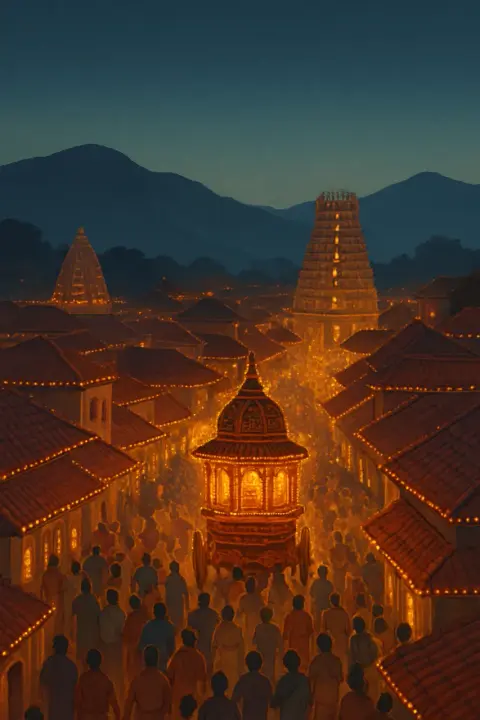
Laksha Deepotsava: a hundred thousand lamps at Dharmasthala
A hundred thousand small flames around a shrine that belongs to no single faith
Laksha Deepotsava, the festival of a lakh (a hundred thousand) lamps, is the five-day festival of Lord Manjunatha at Shri Kshetra Dharmasthala in Dakshina Kannada, Karnataka. It is held over the last five days of the month of Kartika and ends on the new-moon evening, usually between mid-November and mid-December; next: 4–8 December 2026 (expected). Alongside the lamps and processions run an all-faiths conference, the Sarva Dharma Sammelana, and a literary meet. Entry is free, and the final night is the peak.
The Dharmadhikari's office announces the programme at a press meet 10–15 days ahead.
The legend
Legend says that some 800 years ago the guardians of dharma came in human form to the Jain chieftain Birmanna Pergade at Kuduma and were warmly received.
The chieftain built them shrines, and the Brahmin priests asked for a Shiva linga beside them: so the Manjunatha temple came to be.
Ever since, this Shiva temple has had Vaishnava priests and been run by the Jain Pergade family, whose eldest serves as Dharma Adhikari.
Customs
A lakh of lamps
During the festival a lakh, a hundred thousand lamps, is lit at the temple, which gives the festival its name.
Faiths and letters
Alongside run an assembly of different faiths and a literary meet.
What happens over the five days
The festival centres on the utsava (festival) image of Lord Manjunatha, the form of Shiva worshipped at Dharmasthala, and on the lamps that give it its name. As the Ministry of Tourism's festival listing describes it, the festivities begin when the image is carried twice around the sanctum and four times around the temple in procession. The Kshetrapala puja (worship of the guardian of the shrine) follows, and then the image is taken nine times around the temple grounds to music. A silver chariot carries it to Gowrimaru Katte, a platform where the Ashtavadhana puja is performed, and it is brought back to the temple with great celebration.
During the festival the temple and its surroundings are lit with a lakh of lamps, which gives the festival its name; the last night, at the new moon of Kartika, is the peak. The programme between the rituals is cultural: music, traditional dance, Harikatha (storytelling of sacred tales) and bhajans.
Two meetings make this festival unlike other temple fairs. On the fourth day the Sarva Dharma Sammelana brings together speakers from different religions; on the fifth the Sahitya Sammelana is devoted to literature and the fine arts. Both are held every year. Lakhs of devotees come from across Karnataka over the five days.
A Shiva temple that belongs to no single faith
Dharmasthala is a Shiva temple run by a Jain family, with Hindu priests who follow Vaishnava traditions, and its festival is built around a meeting of all faiths. The temple tells its origin as a legend.
About 800 years ago the place was called Kuduma, home of the Jain chieftain Birmanna Pergade and his wife Ammu Ballalthi, known for their hospitality. The guardian spirits of dharma, the Dharma Daivas, came to their house in human form; pleased with their welcome, they asked the chieftain to give his house over to their worship and to build shrines for the four Daivas, Kalarahu, Kalarkai, Kumaraswamy and Kanyakumari. The Brahmin priests he invited asked for a Shiva linga beside them, and the Daivas sent their follower Annappa Swamy to bring the image of Lord Manjunatha from Kadri, near Mangaluru.
In the 16th century Vadiraja Swami of Udupi re-consecrated the linga with Vedic rites and named the place Dharmasthala, "the abode of dharma". Twenty-one generations of the Pergade family, now called Heggade, have run the shrine since; its head serves as Dharmadhikari.
Temple rules and dress code
The temple publishes these as mandatory practices. They apply on festival nights as on any other day.
- Dress — Men remove shirt and vest to enter the sanctum. Men in shorts and women in nightwear are not allowed in for darshan.
- No phones, no bags — Mobile phones may not be used on the temple premises, and bags and food are not allowed inside the temple. Expect security checks.
- Small children — Children under two are not allowed into the sanctum.
- Queues on crowded days — Keep to the queue. The temple warns that darshan, the free meals (annadana) and accommodation can vary on crowded days; breakfast is served in the queue line. If you are separated from your group, go to a police aid post.
Planning a visit
Dharmasthala is a temple town on the Netravati river in Belthangady taluk, in the foothills of the Western Ghats.
- Watch for the programme
The Dharmadhikari's office announces the festival programme at a press meet 10 to 15 days ahead, with the day of each procession and meeting.
- Getting there
The nearest airport is Mangaluru, about 75 km away.
- Book temple rooms officially
The temple runs its own guest houses and says they can be booked only through its official website; it is not responsible for bookings made elsewhere.
- Around the temple
Nearby stands the statue of Bahubali, about 12 m high, carved from a single rock in 1973. The Kukke Subramanya temple festivals of Champa Shashti and Nagaradhane, and the touring Yakshagana season, fall in the same part of the year.
FAQ
What is the Sri Dharmasthala Laksha Deepotsava?
The five-day festival of lights of Lord Manjunatha at Dharmasthala, held over the last five days of Kartika, with processions of the deity, a lakh of lamps, an all-faiths conference and a literary meet.
When is Laksha Deepotsava?
Next: 4–8 December 2026 (expected). It ends on the evening of the Kartika new moon, usually between mid-November and mid-December; the temple confirms the programme 10 to 15 days ahead.
How old is Dharmasthala temple?
By the temple's own account, about 800 years: the shrine began when the Jain chieftain Birmanna Pergade built shrines for the Dharma Daivas at Kuduma, and the Manjunatha linga was installed beside them.
Is there a dress code at Dharmasthala?
Yes. Men remove shirt and vest to enter the sanctum, and men in shorts and women in nightwear are not allowed in for darshan. Phones may not be used on the premises.
Is there an entry fee for Laksha Deepotsava?
No. The festival, the processions and the meetings are free to attend.
Sources (5)
Facts checked: 21 October 2026. Prices and hours are approximate; check locally.