 India GO
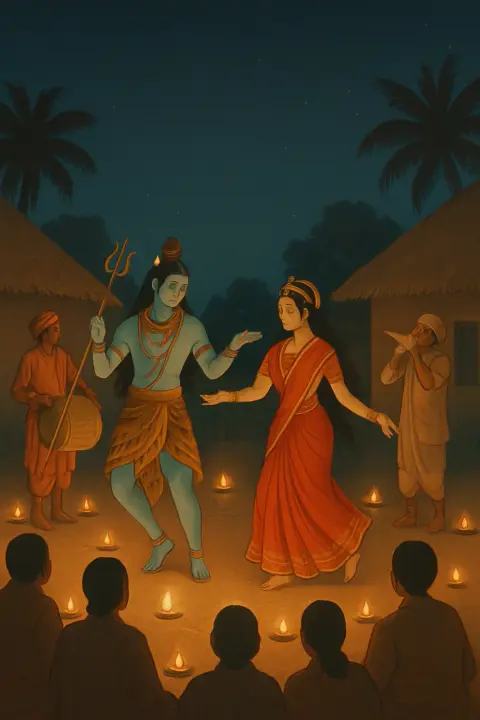
Danda Nata (Danda Jatra): penance and folk theatre of south Odisha
Drums, dust and barefoot vows carried from village to village in the spring heat
Danda Nata, also called Danda Nacha or Danda Jatra, is a festival of penance and performance in south Odisha, above all in Ganjam district around Berhampur. Through the month of Chaitra, men who have taken a vow, the danduas or bhoktas, pray to Kali and Shiva, live austerely and go from village to village performing a chain of dances and a sung drama. It ends on Maha Vishuba Sankranti (Pana Sankranti), the Odia new year: 25 March – 14 April 2027 (expected).
Each troupe fixes its start with its village; the closing day, Pana Sankranti, is in the Odisha holiday list, issued in November or December of the previous year.
The legend
Danda Nata is an old festival of Kalinga, held to be part of the Chaitra festivities at Tara Tarini, the patron goddess of the Kalinga kings.
A folk tale says the word danda was born as Shiva taught Ganesh the tandava: his stamp made dan, and brass from his anklet falling on a drum made da.

The participants, the danduas, take a vow for 13, 18 or 21 days: they pray to Kali and Shiva, eat a single meal of rice and dal, and live austerely.
Customs
A chain of dances
To dhol and mahuri the dances follow one another: Prabhakar and Prabhakariani, played by a man, then Hara and Parvati.
Leela
The troupe acts out a story from the Ramayana, the Mahabharata or a Purana in song and dance, then moves on to the next village.
Words of the festival
ଦଣ୍ଡ ନାଟ
Danda Nata
Danda means a staff and also penance; nata comes from natya: music, dance and drama.
What Danda Nata means
Danda means a staff, and also punishment or penance; nata comes from natya, the word for music, dance and drama together. The festival joins the two: bodily discipline offered to the gods, and theatre performed for the village. The idea behind it is that greatness comes from control over body, mind and speech.
A folk tale gives another origin for the word. While Shiva was teaching Ganesh the tandava, he stamped on the stage and made the sound dan; a piece of brass broke from his anklet and fell on a mardala drum with the sound da. Together they made danda.
Danda Nata is an old festival of the Kalinga country. It is held to be part of the Chaitra festivities at Tara Tarini, the patron goddess of the Kalinga kings: according to folk tradition, the danduas once gathered there to close their penance. Over time it spread to other parts of Odisha, the number of troupes grew, and troupes now close their danda in their own village or locality. Besides Ganjam it is kept in Kandhamal, Dhenkanal, Angul and Gajapati.
The vow of the danduas
Only men take part. A troupe begins on an auspicious day with worship and fasting and keeps its vow for 13, 18 or 21 days, ending on the Sankranti. For that time the danduas live apart from their families, eat a single meal a day of rice and dal, avoid meat and fish and pray to Kali and Shiva. Krishna, Ganesh and Durga are also worshipped in the performances.
The final rites, known in south Odisha as Meru Jatra, close the month on Maha Vishuba Sankranti. They include hard public penances by the most senior devotees, which visitors watch only as bystanders.
What a performance looks like
The music is dhol and mahuri, a drum and a reed pipe. The dances follow in a fixed order. First comes the Parva dance of the Prabhakar and the Prabhakariani, the second role played by a man in a sari; then Hara and Parvati, the dances of Fakir and Fakiriani, Savara and Savarani, Chadeya and Chadouni. Then the troupe performs a leela, a story from the Ramayana, the Mahabharata or a Purana told in song and dance. Patarasaura and Patarasaurani dance after it, and the Binakar closes the performance with his songs.
The songs are devotional, in folk and Odissi style; some are comic, and some are sung as questions and answers between two characters. When it is over, the troupe moves on to the next village.
When and how to see it
Danda Nata is not one event in one place, which makes it hard to plan from afar.
- Dates — Troupes perform from late March to mid-April, up to three weeks. Each troupe fixes its start with its village; the closing day, Pana Sankranti, is in the Odisha holiday list, published late in the previous year. Next: 25 March – 14 April 2027 (expected).
- Where — The villages of Ganjam district, around Berhampur, are the heartland. Ask locally which troupes are performing and where.
- Watch as a guest — Performances happen in village spaces and the danduas are under a religious vow. Ask before photographing, and stand back during the penances.
- Crowds — The closing day draws large crowds to temples. FCDO notes that stampedes have occurred at religious gatherings; keep space and follow local volunteers.
FAQ
What is Danda Nata?
A festival of penance and folk theatre in south Odisha: vowed men pray to Kali and Shiva, live austerely and perform dances and a sung drama from village to village during Chaitra.
In which state did Danda Nata originate?
In Odisha, in the Ganjam district of the old Kalinga country.
When is Danda Nata 2027?
25 March – 14 April 2027 (expected). Troupes perform for 13, 18 or 21 days, ending on Maha Vishuba (Pana) Sankranti in mid-April.
Which god is worshipped in Danda Nata?
Mainly Shiva and Kali; Krishna, Ganesh and Durga are also worshipped in the performances.
What story does Danda Nacha tell?
Each troupe performs a leela from the Ramayana, the Mahabharata or a Purana in song and dance, after a fixed sequence of dances.
Sources (5)
Facts checked: 21 October 2026. Prices and hours are approximate; check locally.