 India GO
Gajan and Charak Puja: how Bengal’s villages close the year
The Bengali year closes with village vows, fasting and drums for Shiva
Gajan is a village festival of Bengal in honour of Shiva, and in some places of the folk god Dharmathakur. It fills the last week of the Bengali month of Chaitra and ends with Charak Puja on Chaitra Sankranti, the last day of the Bengali year; the next morning is Poila Baishakh, the New Year. Charak Puja: 14 April 2027. There is no single venue: each village’s committee runs its own Gajan and sets its own days.
Chaitra Sankranti follows the Bengali solar calendar; each village's Gajan committee sets its own programme, and the West Bengal holiday list carries Poila Baishakh, the day after.
The legend
Gajan is an old village festival of Bengal in honour of Shiva. It fills the last week of Chaitra and sees out the Bengali year.
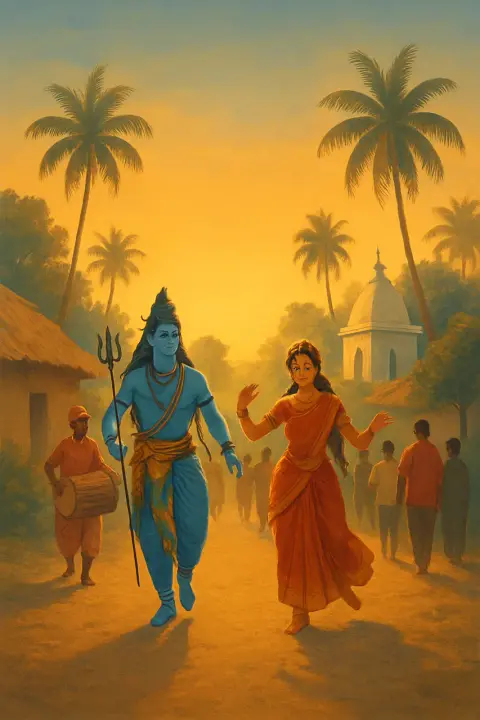
Shiva's Gajan celebrates his marriage to Harakali, and the vowed participants, the sannyasis, become the bridegroom's party.

The festival is meant to bring fertility back in spring. Charak Puja closes it on the last day of the year, and the next morning is Poila Baishakh.
Customs
The bhakta's vow
For the festival the participants, men and women alike, renounce worldly life and keep fasts and vows.
Village round
A month ahead the organisers go from village to village for rice, oil, sugar and honey; at midnight on Sankranti Shiva and Durga are worshipped and prasad shared.
Words of the festival
gajan
From garjan, the roar of the sannyasis, or else read as a festival of village folk.
What Gajan is about
Gajan is a pre-harvest festival. In the Rarh country of western Bengal, hot and dry in Chaitra, it is meant to bring fertility back and restore moisture to the soil. It is kept mainly by rural Bengali Hindu communities who regard themselves as Shiva’s worshippers, and the Shiva of Gajan is a village householder who works the land.
In Shiva’s Gajan the festival celebrates his marriage; in Dharma’s Gajan, found especially in Bankura, it is Dharmathakur who is married. The name is explained in two ways: from garjan, the roar of the vowed participants, or as a festival of the village folk (gram and janasadharan). Its texts come largely from the Dharma Mangal poems of Bengal rather than from Shaiva scripture, and the earliest manual for Shiva’s Gajan dates from the early 20th century.
The vow and the days of Gajan
The heart of Gajan is the vow. For the festival, men and women alike become sannyasis or bhaktas: they take on the sacred thread and give up family life and worldly comforts for its duration, under a chief sannyasi who directs the rites. In Shiva’s Gajan they are the bridegroom’s party. About a month ahead the organisers go round the villages collecting paddy, oil, sugar, salt and honey. Village programmes differ, but a Shiva Gajan usually runs in this order.
- Upos and Habishyi
A day of fasting without water, then the day the sacred thread is taken.
- Mahahabishyi and Phala Utsav
The day of the great fast, followed by a festival of fruits.
- Nil Puja
Shiva’s ceremonial marriage, the eve of the last day.
- 14 April 2027: Charak Puja
The closing rite on Chaitra Sankranti. At midnight Shiva and Durga are worshipped and prasad, the blessed food, is shared.
The austerities and the charak pole
Gajan is a festival of penance, and some of its rites are physical ordeals that participants take on as part of their vow, such as walking on hot coals. The last and best-known of them gives Charak Puja its name: a tall wooden pole, the charak, is raised in the village ground, and some vowed sannyasis are swung around it on ropes.
For those who take part these are offerings made under a vow; they believe the deity protects a sannyasi who keeps it with full faith. Similar pole rites exist elsewhere in India. Programmes differ from village to village, and fasting and worship are as much a part of Gajan as the ordeals. Some visitors find the ordeals hard to watch; stepping back quietly is perfectly acceptable.
Where Gajan is held
Gajan belongs to the villages of southern and western Bengal: rural Hooghly, Bankura, Purulia, Nadia, Malda, Murshidabad and much of Burdwan, as well as Bangladesh. Charak is also seen in north Kolkata. Because each village sets its own programme, there is no central schedule to plan around; it is something to come upon during a stay in Bengal rather than a festival to travel for.
The day after Charak is Poila Baishakh, the Bengali New Year, so the two can be seen in one trip from Kolkata. The city’s other festivals are on festivals in Kolkata.
Watching respectfully
Gajan is open to onlookers, but it is worship and penance, not a show.
- Ask before photographing — Sannyasis under a vow are in the middle of a rite. Ask the organisers or the family before photographing anyone, and never ask for a ritual to be repeated for a camera.
- Keep clear of the pole — Stand well back from the charak and from anyone walking on coals, and follow what the village volunteers ask.
- Dress and shoes — Dress modestly and take off your shoes where the worshippers do, near the shrine.
- Crowds — The UK government advises particular care at large religious gatherings in India, where stampedes have occurred. Agree a meeting point if you go in a group.
FAQ
When is Gajan and Charak Puja?
Gajan fills the last week of Chaitra and Charak Puja is on Chaitra Sankranti, the last day of the Bengali year, usually 13 or 14 April: 14 April 2027. Each village sets its own start.
What is Gajan?
A Bengali village festival of vows in honour of Shiva, and in places of Dharmathakur, held in the last week of Chaitra to see out the year and bring fertility back to the land. It ends with Charak Puja.
What does gajan mean?
It is said to come from garjan, the roar of the vowed sannyasis, or to mean a festival of village folk, from gram (village) and janasadharan (common people).
Who takes part in Gajan?
Vowed participants called sannyasis or bhaktas, men and women alike, who fast, take on the sacred thread and give up worldly life for the festival under a chief sannyasi.
Can visitors watch Charak Puja?
Yes, Gajan is open to onlookers. Keep back from the pole, ask before photographing participants and treat it as worship rather than a spectacle.
Sources (5)
Facts checked: 21 October 2026. Prices and hours are approximate; check locally.