 India GO
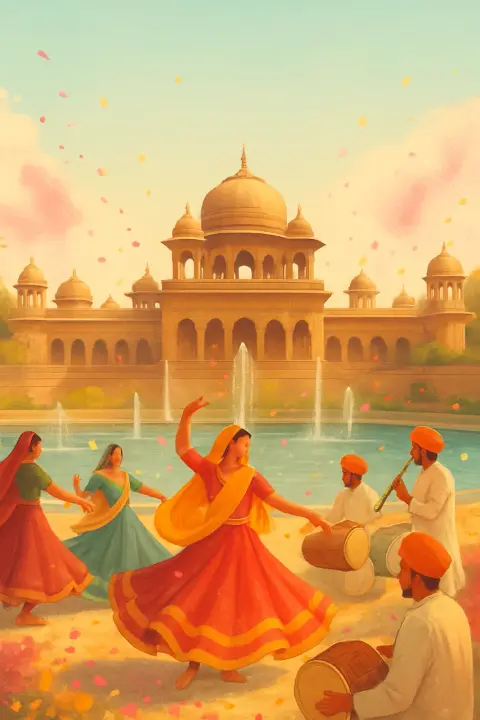
Braj Holi in Bharatpur: coloured fountains at Deeg, temple Holi in Kaman
Coloured water leaping from the fountains of an old Jat palace
Braj Holi is the Rajasthan government's Holi festival for its share of the Braj country, the land where Krishna is held to have grown up. It runs for two days in the bright half of Phalguna, a few days before the rest of India plays Holi, in Deeg, Kaman and Bharatpur in Bharatpur district. Next dates: 17–18 March 2027. The day to aim for is the one at Deeg, when the fountains of an 18th-century Jat water palace are switched on with coloured water.
Rajasthan Tourism publishes the dates years ahead (its current list runs to 2030) and can revise them; the district announces the programme a few weeks before.
The legend

Legend says young Krishna fretted over his dark skin, and his mother told him to colour Radha's face as he wished. Holi recalls that game of colours.
Braj is the country where Krishna is held to have grown up. Its Rajasthan side, Bharatpur district, keeps its own Holi a few days before the rest.
The main stage is Deeg Palace, the 18th-century summer retreat of Bharatpur's Jat rulers, with its gardens and more than 500 fountains.
Customs
Coloured fountains
At Deeg the palace fountains run with coloured water in the afternoon, and a folk programme fills the gardens in the evening.
Temple Holi in Kaman
Kaman plays temple Holi with colour, milk and curd, then processes to the Vallabh Ji temple, with aarti at Vimal Kund at dusk.
Raslila
Troupes perform Raslila, the cycle of Radha and Krishna, and by the afternoon nobody escapes the colour.
Where to celebrate
Bharatpur
A few days before Holi, the Rajasthan side of Braj holds a state festival in Deeg, Kaman and Bharatpur: coloured water in the Deeg palace fountains, temple Holi in Kaman, Raslila and folk evenings.
What happens where
Braj Holi is not one event but a short circuit of three towns, and the order of the programme changes from year to year. In a recent edition it ran three days: Deeg first, then Kaman, then Bharatpur.
Deeg. The main stage is Deeg Palace, begun in the early 18th century by Badan Singh, founder of the Bharatpur state, and enlarged by his son Suraj Mal. It was built as a summer retreat, and its gardens hold more than 500 fountains; one pavilion, Keshav Bhavan, has a water system that imitates falling rain. On the festival afternoon the fountains run with coloured water, and in the evening a folk programme fills the palace grounds. In the morning the Deeg fairground hosts village games and contests, from tug of war to rangoli and a moustache competition.
Kaman. Kaman, the Kamaban of Krishna legend, is a pilgrim town north of Deeg near the Uttar Pradesh border. Its Holi is played in the temples, with gulal (coloured powder) and with milk and curd, and includes lathmar Holi, in which women playfully beat the men with sticks. In the afternoon a folk procession goes to the Vallabh Ji temple, and at dusk there is aarti, the worship with lamps, at Vimal Kund. Kaman also has Chaurasi Khamba, the ruins of a temple and mosque with 84 pillars.
Bharatpur. The base town. In some years it hosts Raslila, the dance drama of Radha and Krishna that Rajasthan Tourism calls the highlight of the festival, and cultural evenings.
Why Holi comes early here
Most of Braj lies in Uttar Pradesh, around Mathura, Vrindavan, Barsana and Nandgaon. Its western edge, Bharatpur district, belongs to Rajasthan, and the state keeps its own festival there, dedicated to Krishna, who is believed to have spent much of his early life in this country. Rajasthan Tourism describes it as a festival that carries the spirit of Holi and re-enacts the love of Radha and Krishna.
The timing follows the lunar calendar: two days in Shukla Paksha, the bright fortnight of Phalguna, a few days before Dhulandi, Rajasthan's day of colours. So the festival falls in late February or March, in the week when the whole of Braj is building towards Holi.
How to plan the trip
Bharatpur is the easiest base: it is on the Delhi–Mumbai railway line, and the closest airport is Agra, about 56 km away.
- Book early
Take a room about a month ahead, and book trains as soon as the 60-day reservation window opens: the festival falls in the week before Holi, when trains through Mathura and Bharatpur are full and Braj hotels are at their busiest.
- Arrive the day before
Bharatpur is about two hours from Agra and four from Delhi. One night is enough for the Deeg day; three nights cover the night before and both festival days.
- Go out by road
Deeg is about an hour north of Bharatpur by road, and Kaman is further north. The district announces the programme a few weeks before, so check which town hosts which day before you set off.
- Stay for the rest of Braj
Lathmar Holi in Barsana and Nandgaon, across the Uttar Pradesh border, comes in the same week, and Holi itself follows in Mathura and Vrindavan. Keoladeo National Park, a 29 km² wetland and World Heritage Site with more than 370 recorded bird species, is at the edge of Bharatpur.
Colour, cameras and crowds
Almost everything is free to watch, and Rajasthan Tourism is plain about the rest: nobody is spared from the colour.
- Dress for it — Wear clothes you can throw away and keep cameras and phones covered. Colour is thrown at everyone, visitors included.
- Deeg Palace entry — The coloured fountains and the evening programme are inside the palace grounds. Ask at the gate whether the usual entry fee applies on festival days.
- Kaman is worship — Temple Holi in Kaman and the aarti at Vimal Kund are religious rites. Follow what people around you do and leave the temple floor to the devotees.
- Large gatherings — The UK Foreign Office notes that stampedes have occurred at events with large crowds, including religious gatherings. Agree a meeting point and keep to the edges in narrow lanes.
More Holi in Braj
- Lathmar Holi of Braj: Barsana and Nandgaon, the stick Holi
- Holi in Mathura
- Holi: the festival across India
- City guides: Mathura, Vrindavan, Agra
FAQ
When is Braj Holi in Bharatpur?
Next: 17–18 March 2027. It is held for two days in the bright half of Phalguna, a few days before Holi. Rajasthan Tourism publishes the dates years ahead and can revise them; the district announces the programme a few weeks before.
Where is Braj Holi celebrated in Rajasthan?
In Deeg, Kaman and Bharatpur, all in Bharatpur district. Deeg has the coloured fountains of its palace, Kaman the temple Holi and the aarti at Vimal Kund, Bharatpur the base and, in some years, Raslila evenings.
Is Braj Holi the same as Lathmar Holi?
No. Lathmar Holi is the stick Holi of Barsana and Nandgaon in Uttar Pradesh. Braj Holi is Rajasthan's festival in Bharatpur district, though Kaman's temple Holi includes a lathmar game too, and the two fall in the same week.
What happens at Deeg Palace during Braj Holi?
In the afternoon the palace fountains, more than 500 of them, are switched on with coloured water, and in the evening a folk programme is held in the palace grounds.
Did Radha and Krishna play Holi?
In Braj tradition, yes. Legend says young Krishna fretted over his dark skin, and his mother told him to colour Radha's face; Holi in Braj recalls that game of colours, and Raslila troupes act it out.
Where should I stay for Braj Holi?
In Bharatpur: it has the railway station, Deeg and Kaman are reachable by road, and Keoladeo National Park is at the edge of town.
Sources (6)
Facts checked: 21 October 2026. Prices and hours are approximate; check locally.