 India GO
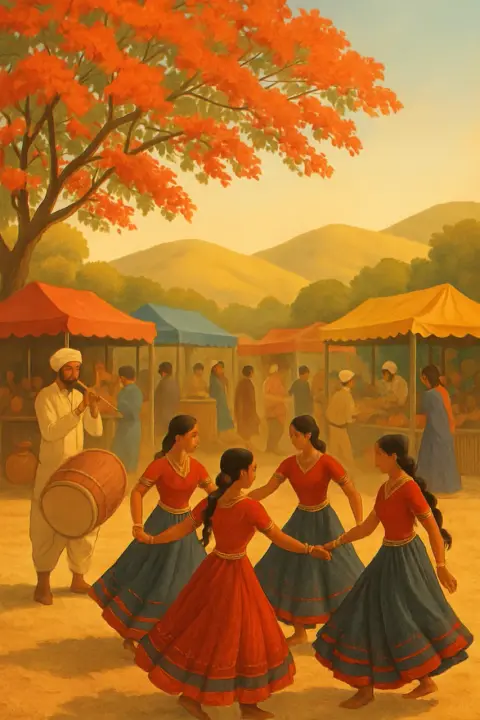
Bhagoria Haat: the Bhil market week before Holi
Mandal drums over a village market dressed in its best for Holi
Bhagoria Haat is the end-of-harvest festival of the Bhil, Bhilala, Patelia, Rathwa and Barela communities of western Madhya Pradesh. For the seven days that end on Holika Dahan, the bonfire night before Holi, each weekly village market (haat) in the Jhabua, Alirajpur, Dhar, Barwani and Khargone districts becomes a festival on its own market day. Dates: 15–21 March 2027 (expected). There is no single venue: the festival moves from village to village, and the district administrations publish the haat-by-haat list a few weeks before.
The week follows Holi; the Jhabua and Alirajpur district administrations publish the haat-by-haat list a few weeks before.
The legend
Bhagoria is an end-of-harvest festival of the Bhil, Bhilala, Patelia, Rathwa and Barela peoples of the Malwa and Nimar country in western Madhya Pradesh.
It runs for the seven days before Holi. Each village keeps it on its own market day, so the festival moves from market to market.
People buy what they need for Holi and meet the whole district. In Gujarat and Rajasthan similar fairs have other names, such as Galaliyu Haat.
Customs
Off to the haat
Families travel to the market in decorated carts, now as often on tractor-trailers, everyone in their best clothes.
The mandal drum
On the market ground people dance to the dhol and the big mandal drum and sing folk songs, lokgeet.
Words of the festival
भगोरिया
haat
A weekly village market; in this week each one becomes a festival.
Where to celebrate
Jhabua
In the week before Holi each Bhil village market in the Jhabua and Alirajpur hills holds its Bhagoria haat on its own day: drums, dancing, silver jewellery and a whole district shopping for Holi.
How the week works
A haat is the weekly market that serves a cluster of villages. In Bhagoria week each one keeps its usual market day, so on any given day the festival is in a different place, and over seven days it travels across the hills of Malwa and Nimar. Each haat runs from late morning to evening on its market ground.
It is still a market first. People come to buy what they need for Holi, and the stalls sell silver jewellery, clay pots, fruit and vegetables. Around the trading, groups of young people move through the fair playing flutes, drums and other percussion, people put gulal (coloured powder) on one another, and people dance to the dhol and the big mandal drum. The Alirajpur district administration also mentions tattooing stalls, where girls have their hands tattooed.
The week is tied to Holi as it is kept in Jhabua and Alirajpur. Here Holika Dahan can fall a day earlier than the Gujarat and national date, so count back from the local bonfire night, not from a national calendar.
The name and where it comes from
The Alirajpur district administration records a local tradition that the fairs began in the time of Raja Bhoj, when two Bhil kings, Kasumar and Balun, started holding them at their capital, Bhagor. Neighbouring Bhil rulers followed, and markets of this kind came to be called Bhagoria. The same page adds that people are not unanimous about this. A Bhil writer interviewed by the news site Newslaundry tells the same story of Kasumar and Balun's fairs at Bhagor, which spread to the villages around it.
You will also see Bhagoria described as an 'elopement festival' or a 'marriage market'. Newslaundry traces the label to anthropological papers from as early as 1973, repeated in the press ever since. Neither the Jhabua and Alirajpur district administrations nor Madhya Pradesh Tourism describe it that way: for them it is a harvest fair and a market. Bhil and Bhilala activists, writers and elders it interviewed said the coverage misrepresents their festival: in their account marriages are arranged by families, and elopement is an exception punished with a fine. This page follows the communities and the official sources: Bhagoria is a harvest fair and market before Holi.
Where to go
Every haat is free and open: it is a public market with no ticket. The order of villages changes every year with the market days, so plan around the official list.
Jhabua town
The district town and the easiest base. Its own Bhagoria haat falls on the town's weekly market day, so its place in the Bhagoria week changes every year.
Walpur, Alirajpur district
A well-known haat, linked locally with the Bhil rulers of old.
Alirajpur town
The second base, with its own haat on its market day.
Dhar, Barwani and Khargone
Village haats in these districts keep Bhagoria too, further from the Jhabua-Alirajpur core.
Etiquette
Bhagoria is the district's own fair, not a show put on for visitors. A few rules make you a welcome guest.
- Watch from the edge — The dancing circles belong to the families and village groups. Stand back and let them have the ground.
- Ask before every photo — Ask before photographing anyone, young women above all, and accept a no.
- Leave the clichés at home — Questions about 'elopement' or 'choosing a bride' are the ones locals hear from outsiders most, and many find them offensive.
- Crowds — The big haats are packed. The UK Foreign Office (FCDO) notes that stampedes have occurred at large gatherings in India: agree a meeting point and keep away from crushes.
How to plan the trip
This part of Madhya Pradesh has almost no tourism infrastructure, so the plan matters more than usual.
- Book the train first
The week before Holi is one of the busiest of the year on Indian Railways. Book to Meghnagar (20 km from Jhabua) or Ratlam as soon as sales open, 60 days ahead. Indore airport is about 150 km away by road.
- Then a room
Jhabua and Alirajpur have only a few basic hotels. Book about a month ahead.
- Arrive two days early
Get the week's haat schedule locally: it is the only reliable way to plan, since village days can shift from the published list.
- Stay three to five nights
Three nights are the minimum and five are better: the haats fall on different days, so a longer stay lets you see several. Mandu and Maheshwar are natural additions to the trip.
FAQ
When is Bhagoria Haat?
Next: 15–21 March 2027 (expected). It is the seven days that end on Holika Dahan as kept in Jhabua and Alirajpur, usually between late February and late March. Each village holds its haat on its own market day.
Where is the Bhagoria festival celebrated?
In the weekly village markets of Jhabua, Alirajpur, Dhar, Barwani and Khargone districts in western Madhya Pradesh. Jhabua and Alirajpur are the heart of it.
Which communities celebrate Bhagoria?
The Bhil, Bhilala, Patelia, Rathwa and Barela peoples of the Malwa and Nimar country. The Alirajpur district administration calls it a trademark celebration of the Bhils.
Is Bhagoria an elopement festival?
Not in the view of the communities themselves. The label comes from older academic papers and the press. The district administrations and Madhya Pradesh Tourism describe Bhagoria as a harvest fair and market, and Bhil people have said the label misrepresents it.
Do you need a ticket for Bhagoria?
No. Every haat is a public market with free entry.
Sources (6)
Facts checked: 21 October 2026. Prices and hours are approximate; check locally.