 India GO
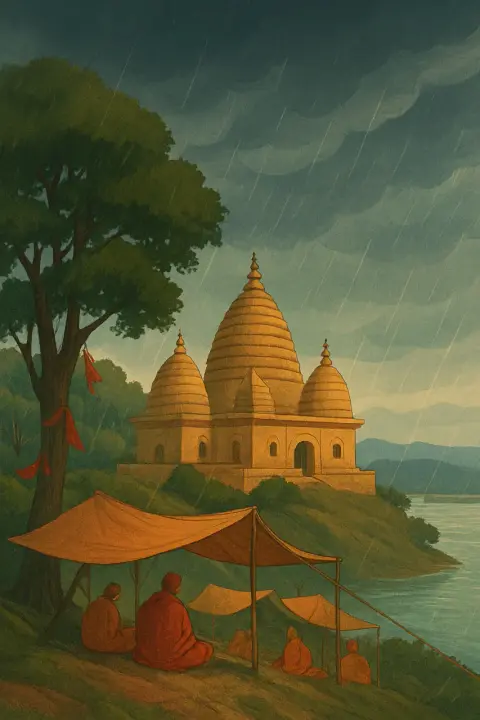
Ambubachi Mela at Kamakhya: three closed days and the reopening
Temple doors shut for three days while ascetics fill the goddess's hill
Ambubachi Mela is the four-day gathering at the Kamakhya temple on Nilachal hill in Guwahati, held when the goddess is believed to go through her yearly menstruation. The sanctum closes for three days, the hill fills with sadhus and pilgrims from across India, and on the fourth morning the doors reopen to the longest queue of the year. Dates: 22–26 June 2027 (expected); the temple publishes the exact closing and opening times a few weeks ahead.
The Kamakhya temple administration announces the closing and opening times one to three weeks ahead; the Kamrup (Metro) district announces the arrangements in May or June.
The legend
Kamakhya on Nilachal hill is one of the oldest Shakti Peethas. There is no idol: the goddess is worshipped as a stone over which a spring flows.

It is believed that at the height of the monsoon the goddess, like Mother Earth, goes through her yearly cycle and rests in seclusion for three days.
So the temple closes for three days; on the fourth the goddess is bathed and the doors open to worshippers again.
Customs
The ascetics' camp
While the temple is shut the hill fills with sadhus, Tantric practitioners and Baul singers from all over India; some appear in public only on these days.
Three quiet days
During these days devotees refrain from cooking, puja, reading holy books and farm work.
Reopening prasad
When the doors reopen, prasad is given out: water from the sacred spring and a strip of the red cloth that covered the goddess's stone.
Where to celebrate
Guwahati
For three days the Kamakhya temple stays shut and Nilachal hill above Guwahati turns into a camp of ascetics from across India; nearly eight lakh people came in 2026.
What happens during the four days
The temple calls the festival Ambubachi Mahayog, and locally it is also known as Ameti. 'Ambu' means water and 'bachi' flowing. It begins when the Sun, in Mithuna (Gemini), enters the first quarter of the Ardra nakshatra, around 21 or 22 June, in the month of Ashar by the Assamese and Bengali calendars, in the middle of the monsoon. The temple ties it to an old agricultural idea: the goddess is worshipped as Mother Earth, and like a fertile woman the earth goes through her cycle.
At the moment called Pravritti the main door of the temple closes. For the next three days no one enters the sanctum, and many devotees keep the days quietly, without cooking, puja, reading holy books or farm work. Outside, Nilachal hill turns into a camp. Sadhus, Tantric practitioners, black-clad Aghoris and Baul singers from Bengal set up along the paths, and some ascetics appear in public only in these days.
On the fourth morning, at Nivritti, the goddess is given a ritual bath and the daily puja, and the doors reopen for darshan. There is no idol at Kamakhya: the goddess is worshipped as a stone over which a spring flows. The prasad of the reopening is in two parts, angodak, water from the spring, and angabastra, a strip of the red cloth that covered the stone during the closed days.
The Kamakhya temple
Kamakhya is counted among the oldest four of the 51 Shakti Peethas, the seats of the goddess in the Shakta tradition. The structure is dated to the 8th or 9th century, with many later rebuildings. A tradition holds that the temple was destroyed by Kalapahar, a general of the Bengal sultan Sulaiman Karrani, but historians now place the destruction during Hussain Shah's invasion of the Kamata kingdom in 1498. The Koch king Naranarayana rebuilt it in its present form in 1565, and the Ahom kings later supported the temple. Its local style of architecture is called Nilachal, after the hill.
On the hill: access, queue and etiquette
The mela draws very large crowds: nearly eight lakh (800,000) pilgrims at a recent mela, by press reports. Arrangements are announced by the temple and the Kamrup (Metro) district in May or June, and Guwahati police publish the traffic plan.
- On foot up Nilachal hill — Vehicles are stopped at the foot of the hill and the climb is on foot. Transit camps for pilgrims are set up near Kamakhya railway station and Pandu Port.
- Footwear stays below — Shoes are left at the designated camps on the approach road; no one goes past the temple's main entrance with footwear.
- One queue for everyone — On the reopening days the paid special darshan (about ₹501) and the special entry for defence personnel are suspended, so everyone stands in the general queue, which is free. It is the longest queue of the year.
- Ask before photographing — The ascetics' camps line the paths on the hill and can be walked past. Ask before taking a picture of anyone.
Where to stay and when to arrive
The hill itself has only camps and dharamshalas, so plan to stay in Guwahati and come up on foot.
- Book about two months ahead
Guwahati's hotels fill for the mela. Trains to Guwahati and Kamakhya stations open for booking 60 days ahead and are worth booking in the first days of sale.
- Arrive the day before it opens
Be in Guwahati the day before the closing moment, Pravritti, so you can see the hill during the closed days and stay for the reopening.
- Check the official times
The temple's own site, maakamakhya.org, posts the Pravritti and Nivritti times and the rules for devotees one to three weeks before the mela.
FAQ
When is Ambubachi Mela?
Next: 22–26 June 2027 (expected). The temple closes at the Pravritti moment on the first day and reopens on the morning of the fourth; the exact times are published by the temple a few weeks ahead.
Where is the Ambubachi Mela celebrated?
At the Kamakhya temple on Nilachal hill in Guwahati, Assam.
Is the Kamakhya temple open during Ambubachi?
No. The sanctum is closed for three days and reopens on the fourth morning after the goddess's ritual bath. The hill and the ascetics' camps stay open.
What is the cost of a VIP ticket in Kamakhya?
The temple's special darshan costs about ₹501, but it is not available on the reopening days of the mela, when everyone uses the free general queue.
Who destroyed the original Kamakhya temple?
Tradition names Kalapahar, a general of Sulaiman Karrani, but historians now place the destruction during Hussain Shah's invasion in 1498. The Koch king Naranarayana rebuilt the temple in 1565.
Sources (5)
Facts checked: 21 October 2026. Prices and hours are approximate; check locally.