 India GO
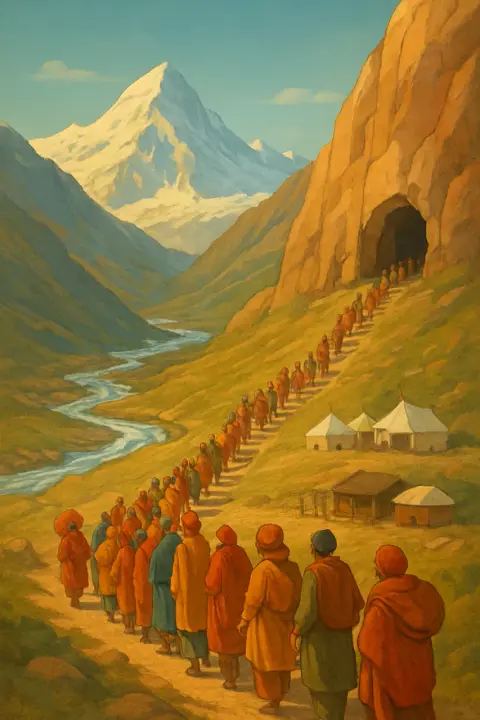
Amarnath Yatra: registration, health certificate and the routes to the cave
A walk above the tree line to a lingam of ice in a mountain cave
The Amarnath Yatra is the summer pilgrimage to a cave at about 3,888 m in the Kashmir Himalayas, where an ice stalagmite is worshipped as a lingam of Shiva. The route is open for a few weeks a year, only to registered pilgrims with a Compulsory Health Certificate. The Shri Amarnathji Shrine Board sets the opening day each year, usually late June or early July; the season closes on Shravan Purnima, the Raksha Bandhan full moon: next, 17 August 2027 (expected). The UK government (FCDO) advises against all travel to Jammu and Kashmir, and the whole route lies inside that area: read the travel advice below first.
The Shrine Board announces the season in March or April, and registration opens in April.
The legend
Legend says that in this cave Shiva revealed to Parvati the secret of life and immortality, the amar katha.
On the way he left behind all worldly things: the bull Nandi at Pahalgam, the crescent moon at Chandanwari, the serpent Vasuki at Sheshnag Lake.
His son Ganesha stayed on Mahagunas mountain and the five elements at Panchtarni; then, after dancing the tandava, he entered the cave with Parvati.
A pair of pigeons, it is believed, overheard the secret and became immortal; pilgrims still look out for them in the cave.
Shiva and Parvati took form here as the ice lingam, and every summer pilgrims climb up to it.
Meaning
Valley Muslims
In the late 19th century the Maliks of Batkoot ran the route to the cave, and local Bakarwal and Gujjar Muslims still earn a living serving pilgrims.
Customs
Chhari Mubarak
Shiva's holy mace is carried from the Dashnami Akhara in Srinagar via Pahalgam, Chandanwari, Sheshnag and Panchtarni and brought into the cave on the Shravan full moon.
Langars
All along the route, langars, free kitchens run by voluntary groups, feed the pilgrims.
The yatra's rule
Pilgrims go up by registration and with a doctor's certificate, first spending a few days getting used to the altitude in Pahalgam or Sonamarg.
Words of the festival
अमरकथा
amar katha
'the tale of immortality', the secret Shiva told Parvati in the cave
बाबा बर्फानी
Baba Barfani
'the father of snow', the fond name of the ice lingam
पंचतरणी
Panchtarni
'five streams', a meadow where five glacier-fed streams meet
शेषनाग
Sheshnag
a mountain lake on the route, named after Shesha, king of the nagas
How to greet
बम बम भोले
Bam Bam Bhole!
The pilgrims' cry: Bhole, 'the innocent one', is a fond name for Shiva. Groups set off from the camps for the cave with it.
True or myth
❌ Myth. The route opens only for the season, from late June or early July to the Shravan full moon, and only to registered pilgrims.
✅ True. Water drips from the cave roof, freezes on the floor and builds up into an ice stalagmite.
❌ Myth. Back in the 12th century, Kalhana's Kashmiri chronicle Rajatarangini named the shrine Amareshvara and mentioned the pilgrimage to it.
Where to celebrate
Pahalgam
Worth the trip
Three to five days on foot from Pahalgam, or one long day from Baltal, to the ice lingam in a cave at about 3,888 m, open only to registered pilgrims with a health certificate.
Travel advice for Jammu and Kashmir
The UK Foreign, Commonwealth & Development Office (FCDO) 'advises against all travel to the Union Territory of Jammu and Kashmir (including Pahalgam, Gulmarg, Sonamarg, the city of Srinagar and the Jammu-Srinagar national highway)', except for travel by air to and from the city of Jammu and travel within the city of Jammu. The whole yatra route lies inside that area. FCDO also notes that travel insurance could be invalidated if you travel against its advice. Other governments publish their own advice; read your own country's before booking.
In India, the Ministry of Home Affairs reviews security for the yatra along the route and at the camps, and pilgrim batches move according to the weather and forecasts. Heavy rain can suspend the yatra on one or both routes, and in recent seasons it has closed early for that reason. Notices come from the Shrine Board at jksasb.nic.in.
More: Is India safe? and travel insurance.
How the yatra works
There are two routes, and pilgrims register for a route and a date of travel; the current rules are on the Shrine Board's site.
From Pahalgam, the traditional route, you start at Nunwan base camp and pass the Chandanwari gate about 12 km further on, then walk three to five days with night halts at Sheshnag lake and Panchtarni. From Baltal, near Sonamarg, the short route leaves through the Domail gate and climbs about 14 km to the cave in one long, steep day.
On both routes there are tented camps, and langars, free kitchens run by volunteers, feed pilgrims the whole way. At the cave the queue is managed and darshan, the sight of the deity, is brief; photography inside is not allowed.
The season closes when the Chhari Mubarak, Shiva's holy mace, is carried from Srinagar and brought into the cave on the Shravan full moon. Its public rites in Srinagar and Pahalgam are open to all.
Registration and the health certificate
Registration rules are set by the Shrine Board and change every season. Only its official site, jksasb.nic.in, has the current guidelines and forms: check eligibility, fees and documents there before you plan anything.
- Get the Compulsory Health Certificate
Every pilgrim needs a Compulsory Health Certificate. Check on the Board's site which doctors or institutions may issue it, on which form, and from what date it counts as valid.
- Check who may register
The Board sets age limits and rules for pregnant women each season. Check the current limits with the Shrine Board before you get the certificate.
- Register for a route and a date
Registration opens in spring. How and where to register, the fee and the daily limits are published by the Board; check them on jksasb.nic.in.
- Not an Indian resident?
Foreign nationals and NRIs should ask the Shrine Board whether and how they can register before planning the trip.
- Carry what the gates require
Pilgrims pass access gates at Chandanwari or Domail. Check with the Board which documents and cards you must collect beforehand and carry.
Altitude and health: the Shrine Board's advice
The route climbs to about 14,000 ft (over 4,200 m), and the Shrine Board's health advisory warns that altitude sickness, if not treated in time, can be fatal within hours. The advisory, published by the Ministry of Home Affairs, comes down to these points; they do not replace a doctor.
- Train, then climb slowly — Walk 4–5 km a day for at least a month before the yatra and practise deep breathing and pranayama. On the route, walk slowly, take time to acclimatise, rest on steep stretches and do not push beyond your normal capacity.
- Water, food, no alcohol — Drink about 5 litres a day, eat plenty of carbohydrates, and avoid alcohol, caffeinated drinks and smoking.
- Go down at the first symptoms — Nausea, vomiting, dizziness, fast breathing or confusion mean stop, descend at once and go to the nearest medical post; the advisory says they are about every 2 km. If your health changes after the certificate is issued, see your doctor again.
Planning the trip
Fix the registration date first, and choose one early in the season: rain has closed the routes before the last day in recent seasons.
- Then book transport
Then book the flight to Srinagar or the train to Jammu; trains open 60 days ahead and fill fast in the season.
- Allow four to six nights
On the Pahalgam route: a night or two in Pahalgam to acclimatise, then Sheshnag and Panchtarni, and a night at Baltal after coming down, sleeping in tented camps on the way.
- Plan to walk
Helicopter services have not run in recent seasons, so plan as if you will walk the whole way.
FAQ
When does the Amarnath Yatra start and end?
The Shrine Board announces the opening day each spring, usually for late June or early July. The yatra closes on Shravan Purnima, the Raksha Bandhan full moon: next, 17 August 2027 (expected).
Where does the Amarnath Yatra start from?
From one of two base camps: Nunwan at Pahalgam, with the gate at Chandanwari, for the traditional three-to-five-day route, or Baltal near Sonamarg, with the gate at Domail, for the short route of about 14 km.
How do I apply for the Amarnath Yatra?
Get a Compulsory Health Certificate, then register for a route and a date when registration opens in spring. The Shrine Board publishes the current procedure, fees and eligibility on jksasb.nic.in; foreign nationals and NRIs should check with the Board how they can register.
Is Amarnath open all year?
No. The cave can be reached only during the yatra season, from late June or early July to the Shravan full moon, and only by registered pilgrims.
How high is Amarnath cave?
About 3,888 m (12,756 ft). The Shrine Board's health advisory says the trek reaches altitudes of about 14,000 ft (over 4,200 m).
Who cannot register for the yatra?
The Shrine Board sets age limits and rules for pregnant women each season, and they can change. Check the current eligibility rules on jksasb.nic.in before you get the health certificate.
Sources (8)
- Shri Amarnathji Shrine Board (official site)
- FCDO: India travel advice, warnings and insurance
- PIB: Health advisory for yatris during Shri Amarnathji Yatra
- PIB: security review for the Shri Amarnath Ji Yatra
- Amarnath Temple
- Amarnath Yatra suspended on both routes amid rains, Outlook India
- Shri Amarnathji Shrine Board: how to reach
- No helicopter service for this year's Amarnath Yatra, Outlook India
Facts checked: 21 October 2026. Prices and hours are approximate; check locally.