 India GO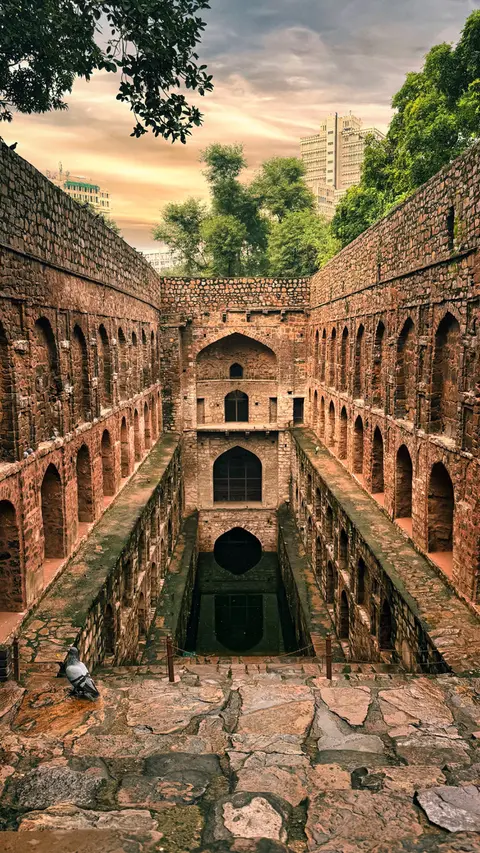
Agrasen Ki Baoli, Delhi
Agrasen ki Baoli is a medieval stepwell on Hailey Road, a short walk from Connaught Place: 108 steps down between stone walls, 60 m long and 15 m wide. Delhi Tourism lists it as open every day from 9 am to 5:30 pm, and entry is free. The nearest metro stations it gives are Mandi House and Janpath.
One of Delhi's most photogenic and mystical sites: an ancient stepped well hidden among glass office buildings right in the city center. Legend attributes the original stepwell to the mythical king Agrasen of the Mahabharata era; the surviving structure is 14th-century Tughlaq/Lodi work. 108 steps descend to the water, and with each level the walls close in tighter; the feeling is simultaneously enchanting and eerie. The place is quiet and uncrowded. Entry is free. It's within walking distance of Connaught Place.
A mystical stepwell
Tickets
Timings and entry fee
Delhi Tourism gives the hours as 9 am to 5:30 pm, open all days. The baoli is protected by the Archaeological Survey of India (ASI), but it is not among the ticketed ASI monuments in Delhi: entry is free, as the card above shows.
The baoli is a long stone staircase with no step-free access, so it is not wheelchair accessible.
What you see inside
A baoli is a stepwell: a reservoir reached by flights of steps, built to hold water through the dry months and, in medieval times, a cool place to gather and rest. Here 108 steps descend in three visible levels, each lined with arched niches on both sides, and with every level the walls close in tighter. At the bottom the water has dried up; Incredible India notes that it was once said to be black.
The effect comes from the contrast. Glass office towers stand right above the rim. A small three-sided mosque stands on the western side. The place is usually quiet and uncrowded, and is popular with photographers; Bollywood has used it too, including in PK and Sultan.
History and legends
No record names the builder. Local tradition credits King Agrasen, the legendary ancestor of the Agrawal trading community who ruled from Agroha; another story places the first well in the age of the Mahabharata. The structure that survives is medieval: it was most likely rebuilt or repaired under the Tughlaq or Lodi sultans in the 14th or 15th century.
The baoli also has a reputation as one of Delhi's haunted places. Folklore says its dark water drew people into a trance and down to their deaths. Incredible India is plain about it: there is no evidence for any of it. The stories are part of why people come, not a reason to stay away.
Nearest metro station
Delhi Tourism lists Mandi House (Blue Line) and Janpath (Yellow Line). The baoli is tucked into a lane off Hailey Road in central Delhi, within walking distance of Connaught Place and near Jantar Mantar, so it fits easily into a day around the centre.
 Before you go
Wear shoes with grip for the 108 stone steps. This is a protected ASI monument, so do not climb on the walls or into the niches.
❓ FAQ
What are Agrasen ki Baoli timings?
9 am to 5:30 pm, every day, according to Delhi Tourism.
What is the entry fee for Agrasen ki Baoli?
There is none. Entry is free; the baoli is not on the ASI's list of ticketed monuments in Delhi.
Which is the nearest metro station to Agrasen ki Baoli?
Delhi Tourism lists Mandi House on the Blue Line and Janpath on the Yellow Line.
What is the history of Agrasen ki Baoli?
Tradition links it to King Agrasen, but no record names the builder. The present stepwell dates from the Tughlaq or Lodi period, 14th or 15th century.
Is Agrasen ki Baoli haunted?
That is folklore. Incredible India notes there is no evidence of anything paranormal.
Can I visit Agrasen ki Baoli at night?
No. It closes at 5:30 pm.