 India GO
Lakes in Ajmer
Ajmer has two lakes worth the trip. Ana Sagar, dammed in the 12th century, sits inside the city with Shah Jahan's marble pavilions and Jahangir's garden on its shore; Foy Sagar, now officially Varun Sagar, is a 19th-century lake ringed by hills about 5 km west. Both are free, both are best from October to March, and both are full of birds in winter.
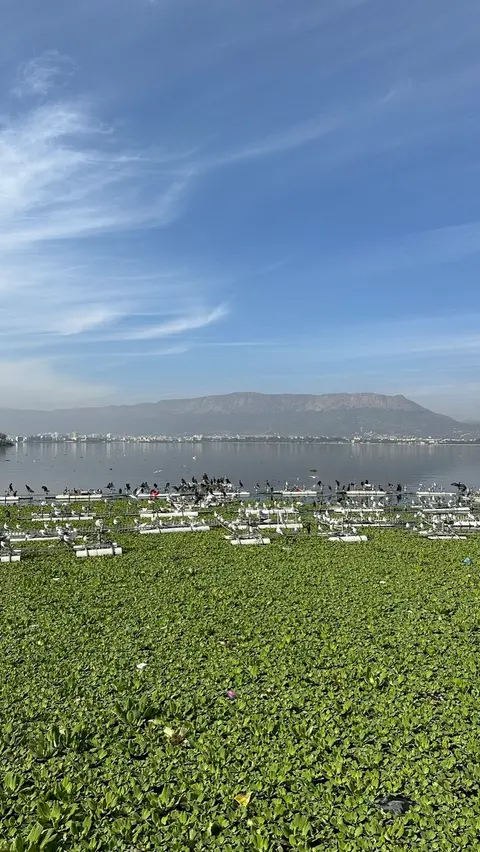
Ana Sagar: the lake in the city
Ana Sagar was made in the 12th century by Arnoraja, known as Ana, the Chauhan king who was the grandfather of Prithviraj Chauhan; Wikipedia dates the work to 1135–1150. By the Chauhan account he built it on the plain where he had beaten an invading army, and the city has lived beside the water ever since. It is the largest lake in Ajmer, and shallow: about 4.4 m at its deepest.
The Mughals gave the shore its present shape. Jahangir laid out Daulat Bagh around 1615, in the years he held court in Ajmer: a charbagh, the four-part Mughal garden cut by water channels, now the public park called Subhash Udyan. In 1637 Shah Jahan added the Baradari, white marble pavilions on the embankment, each open on twelve arches (which is what baradari means). The pavilions are free and never closed.
Boats go out from the east side of Daulat Bagh to the island in the middle of the lake, and the Chowpatty and jetty walkways run along the water next to it. On the lake shore, Rishi Udyan is where the ashes of the reformer Dayananda Saraswati were scattered, by his wish; it has a working Arya Samaj temple and is a known sunset point.
The map and the places around the shore are on the Ana Sagar Lake page.
Foy Sagar (Varun Sagar): the evening lake
About 5 km west of the centre, Foy Sagar is wide, shallow water in a bowl of Aravalli ridges. It was dug in 1892 as famine relief work and named after Mr Foy, the English engineer who designed it; its official name is now Varun Sagar, and signs and maps may use either. The hills close the horizon almost all the way round, and this is where Ajmer itself comes at the end of the day. Entry is free.
The water level follows the rain. The lake is fullest from the end of the monsoon into winter and drops sharply through the dry months, so a visit in late spring can mean a lot of shore and not much lake.
Birds on the water
Ana Sagar is a working wetland and a wintering stop on the migration route through central Rajasthan, and the promenade puts you a few metres from the birds. The Bombay Natural History Society and local groups have run bird walks along the Baradari lakefront. These are the species recorded on the lake that are easiest to find.
Painted stork
Fishes in front of the marble pavilions, and is on the lake all year.
Great white pelican
Present all year and more numerous from November to February; on Ana Sagar it feeds close to the public path, which is an unusually near view of a bird this size.
Black-winged stilt
The commonest waterbird on the lake. In winter the water draws back from the promenade and leaves the shallows and mud it needs.
Red-wattled lapwing
Called titahri across northern India; one of the five commonest birds on Ana Sagar, and a loud one, because it nests on bare ground.
River tern and pied kingfisher
Both fish over open water in the middle of the lake. The tern breeds here, a sign that the lake holds plenty of fish.
When to go
October to March is the season in Ajmer: the lakes are full after the monsoon, the winter birds are in, and the days are mild. May and June are the months to avoid, with daytime highs around 40 °C. July to September brings most of the year's rain and fills the lakes again.
On Ana Sagar, the first light belongs to the birds and to the Baradari, where the low sun is on the marble before the city is up; evenings are when the whole city walks the shore at Daulat Bagh. For Ana Sagar and the city in one view, the Nag Pahar ridge on the Pushkar road has a marked trail to a crest with Ana Sagar behind you and the Pushkar valley in front. Above the lake, the cave shrine of Chilla Khwaja Sahib is where, by tradition, Khwaja Moinuddin Chishti stayed on first reaching Ajmer.
FAQ
Which famous lake is in Ajmer?
Ana Sagar, the 12th-century lake in the city, with Shah Jahan's marble Baradari pavilions and Jahangir's Daulat Bagh garden on its shore. Foy Sagar (Varun Sagar), 5 km west, is the second.
How far is Ana Sagar Lake from the centre of Ajmer?
It is in the city itself, north-west of the railway station. Autos run there from the station; agree the fare before you set off, as there are no meters.
Can I go boating on Ana Sagar, and how much does it cost?
Yes, boats are hired on the east side of Daulat Bagh and go out to the island in the middle of the lake. Boat fares are not in the India GO database, so ask at the jetty before you get in.
Is there an entry fee for Ana Sagar Lake?
The Baradari pavilions are free and never closed. Daulat Bagh is free or charges a token fee, and Foy Sagar is free.
Is Varun Sagar the same as Foy Sagar?
Yes. Foy Sagar, the 1892 lake west of the city, now officially carries the name Varun Sagar.
Sources (4)
Facts checked: 15 October 2026. Prices and hours are approximate; check locally.
The full catalogue, hidden spots and districts on the map, plus “nearby” mode.
Open in India GO