 India GO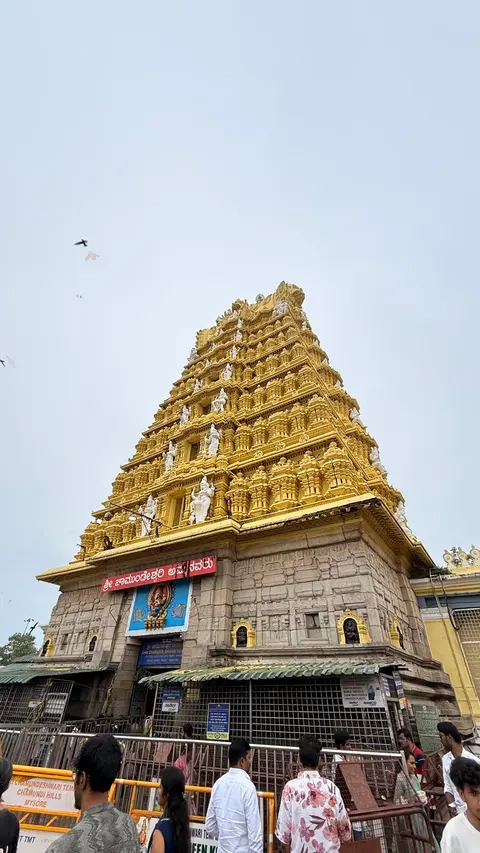
Chamundi Hill, Mysore
The Goddess Hill
Chamundi Hill rises above Mysore with the temple of Chamundeshwari, the guardian goddess who slew the demon Mahisha and gave the city its name, on top. Pilgrims climb a stone stairway of 1,008 steps past a giant Nandi carved from a single boulder; everyone else takes the road. It is a half-day from the centre, best started early.
👥 Who it suits
the goddess temple the city from above the halfway Nandi
 Staying here
No stays: a half-day climb from the centre.
🌙 In the evening
At dusk the city lights up below, but descend before dark.
 Getting there
Taxi or bus uphill · or the 1,000-step stair
What to see


👣 The hill in order, bottom to top
The stairway was built in 1659 under Dodda Devaraja Wodeyar. Many pilgrims climb barefoot; start before sunrise, because the stone heats up and the temple queue grows through the morning.
- The steps
The 1,008 steps start at the foot of the hill. If the climb is too much, ride up and walk down instead, passing the same Nandi.
- Nandi, halfway
Roughly midway stands Nandi, Shiva's bull, 4.9 m tall and 7.6 m long, carved from one block of black granite; larger than the one at Bangalore's Bull Temple.
- Chamundeshwari temple
General darshan (viewing of the deity) is free; paid special-darshan tickets shorten the queue, though the difference is not always large. Shoes come off at the entrance. Timings and tickets are on the Chamundeshwari Temple page.
- Mahabaleshwara temple
A few steps behind the temple square stands a small Shiva temple dated by inscriptions to around 950 CE, the hill's first sanctuary; the hill carried its name before the goddess became famous. No ticket, shoes off, and usually nobody about.
- The viewpoint
From the top the city reads like a map: the palace, the spires of St Philomena's, Karanji Lake, the racecourse. Sunset is the obvious hour; a clear early morning gives sharper distance.
Getting up and getting back
The temple is about 13 km from the centre by road. KSRTC buses run from the Mysuru city bus stand to the hilltop every 20–30 minutes, according to the temple; a scooter or taxi takes the same road. See getting around Mysore. At dusk the city lights up below, but plan to come down before dark: after dark use a metered rickshaw or an app cab rather than walking or riding the hill road.
When to come
Early morning on a weekday is the quietest time for darshan. Weekends and festival days are the busiest, and two periods are in a league of their own: the Fridays of Ashada, the monsoon month (roughly July to early August), which is the temple's own peak, and Dasara (11–21 October 2026), when the goddess is carried through the city. More on the Durga temples of Mysore page. Mysore is comfortable year-round, most of all from October to February.
There are no stays on the hill itself. Lalitha Mahal Palace, a heritage hotel, stands on the slope below, about 5 km east of the centre, and the sights of the palace and Devaraja area fill the afternoon after the climb.
❓ FAQ
How many steps are there on Chamundi Hill?
1,008 stone steps, built in 1659, with the giant Nandi roughly halfway.
Is there a bus to Chamundi Hill?
Yes: KSRTC buses leave the Mysuru city bus stand for the hilltop every 20–30 minutes.
Who built the Chamundeshwari temple?
The hill's shrine is ancient, but the temple owes its fame to the Wodeyars of Mysore, and the stairway was built under Dodda Devaraja Wodeyar in 1659. The older Mahabaleshwara shrine nearby dates to around 950 CE.
What is the best time to visit Chamundi Hill?
Early morning on a weekday. Avoid Ashada Fridays and Dasara unless you come for the festival.
Is entry to the temple free?
Yes, entry and general darshan are free; only the faster special-darshan queues are paid.
Facts checked: 12 October 2026. Prices and hours are approximate; check locally.
Other areas of Mysore
In the app: the city's areas on the map, the places inside and a route.
Open in India GO