 India GO
Durga temples in Delhi
दुर्गा
Delhi's goddess temples are of two kinds: one very old and small, the rest modern and enormous, and in Navratri all of them fill before dawn. The list above holds two goddess temples, the Chhatarpur temple of Katyayani and Yogmaya in Mehrauli, plus the Jhandewalan Hanuman temple, which is Hanuman's, not the goddess's. Below is how the goddess is worshipped in each, which other Devi temples Delhi goes to in Navratri, and the 2026 dates. For every other kind of temple, see the [Delhi temples page](/en/delhi/temples/).
 Durga
Durga
The warrior goddess and the face of Shakti, the energy from which everything is born; often seen as the fierce form of Parvati.
One goddess, many names
Durga is the warrior face of Shakti: the gods could not defeat the buffalo demon, so each gave her a weapon and she rode out on a lion. In Delhi you rarely meet her under that one name. At Chhatarpur she is Katyayani, the sixth of the Navadurga, the nine forms of the goddess honoured one per night of Navratri. In Mehrauli she is Yogmaya, worshipped as Krishna's sister and a form of Durga. In everyday Hindi she is simply Mata, Mother, and many of her temples are known as a Mata mandir. More about her: Durga.
 The three places on the list
Entry is free at all three; shoes come off at the door.
Chhatarpur: Katyayani's temple city
Founded in 1974 by Baba Sant Nagpal, the Shri Adya Katyayani Shaktipeeth has grown over some 70 acres of carved white marble on Delhi's southern edge, with a 101-foot Hanuman over the gate. The inner shrine of Katyayani opens only for the two Navratris a year, when the queues begin as early as 4:00; the rest of the complex is open daily. Chhatarpur station on the Yellow Line is the nearest metro.
Yogmaya: the old goddess of Mehrauli
A small temple a few hundred metres from the Qutub complex, held by tradition to be the only temple in Delhi older than the Sultanate still in worship; the present building dates from 1827. The goddess is black stone, and she is considered austere: bells are not rung in her worship, and wine and meat are never offered. More: Yogmaya Temple.
Jhandewalan Hanuman: a Hanuman temple, not a goddess temple
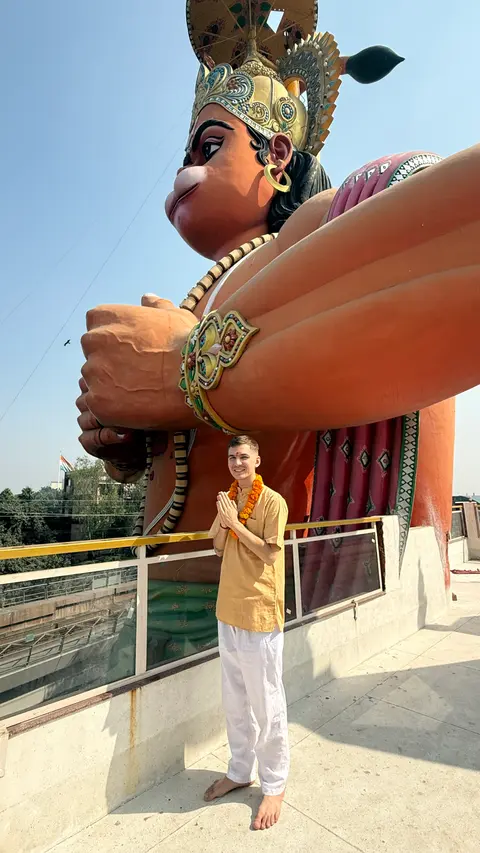
A temple of Hanuman, best known for its 108-foot figure of him, visible from the Blue Line, opening his chest to show Rama and Sita within. It is easily confused with the Jhandewalan Devi temple close by, a separate temple and one of the city's most visited goddess temples in Navratri. Jhandewalan metro station serves both. More: Jhandewalan Hanuman Temple.
Other goddess temples Delhi goes to
Two more are not on the list but belong in the picture. Kalkaji Mandir, the temple of Kali (the goddess's dark, fierce form) opposite Nehru Place, has its own metro station, Kalkaji Mandir on the Violet and Magenta lines, and draws Navratri queues and road diversions. And at the Laxminarayan Temple (Birla Mandir), the tower on the left of the main shrine houses Durga.
❓ FAQ
Which Durga temple is the most famous in Delhi?
In Navratri the biggest crowds go to the Chhatarpur temple of Katyayani, the Jhandewalan Devi temple and Kalkaji Mandir. Yogmaya in Mehrauli is held by tradition to be the oldest.
Where is Maa Kalka Mandir in Delhi?
Kalkaji Mandir stands opposite Nehru Place in south Delhi, by Kalkaji Mandir metro station on the Violet and Magenta lines.
When does the main shrine at Chhatarpur open?
The inner Katyayani shrine opens only during the two Navratris each year; the rest of the complex is open daily.
When is Navratri 2026 in Delhi?
11–19 October 2026 (projected), with Ashtami on 19 October and Dussehra on 20 October.
Is Chhatarpur temple a Shakti Peeth?
Its name is Shri Adya Katyayani Shaktipeeth, but it is a modern temple, founded in 1974, not one of the ancient pithas of the goddess.